What a safety relay does
A safety relay is a control device used to monitor safety-related inputs and switch safety outputs according to the machine’s safety design.
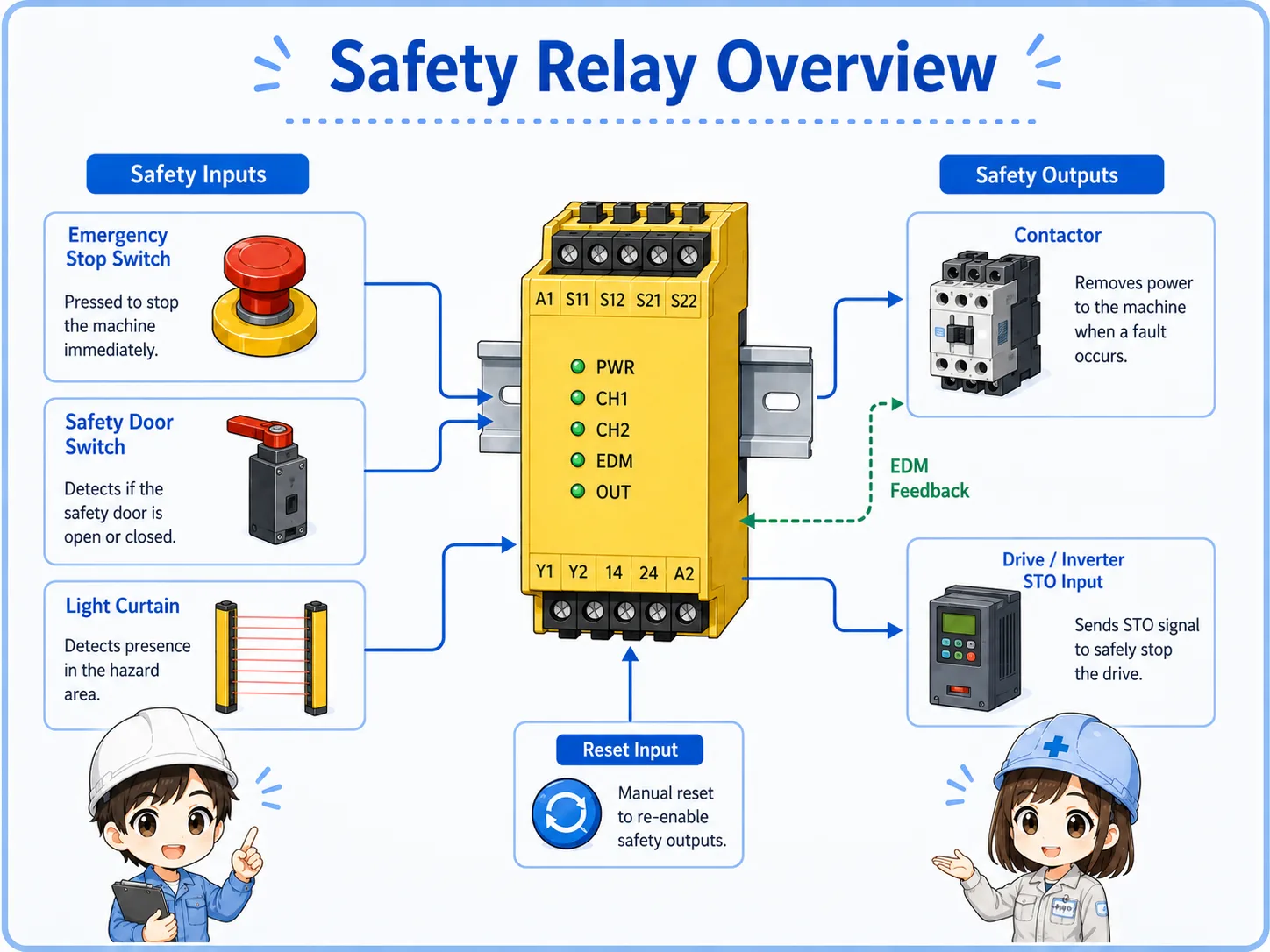
For example, an emergency stop switch, safety door switch, or light curtain may connect to the safety relay. The relay checks whether the safety input path is normal. If the input path opens or becomes abnormal, the safety relay turns off its safety outputs.
Those outputs may remove power from contactor coils, remove enable signals, or turn off STO inputs on an inverter or servo drive.
Safety inputs: CH1 and CH2
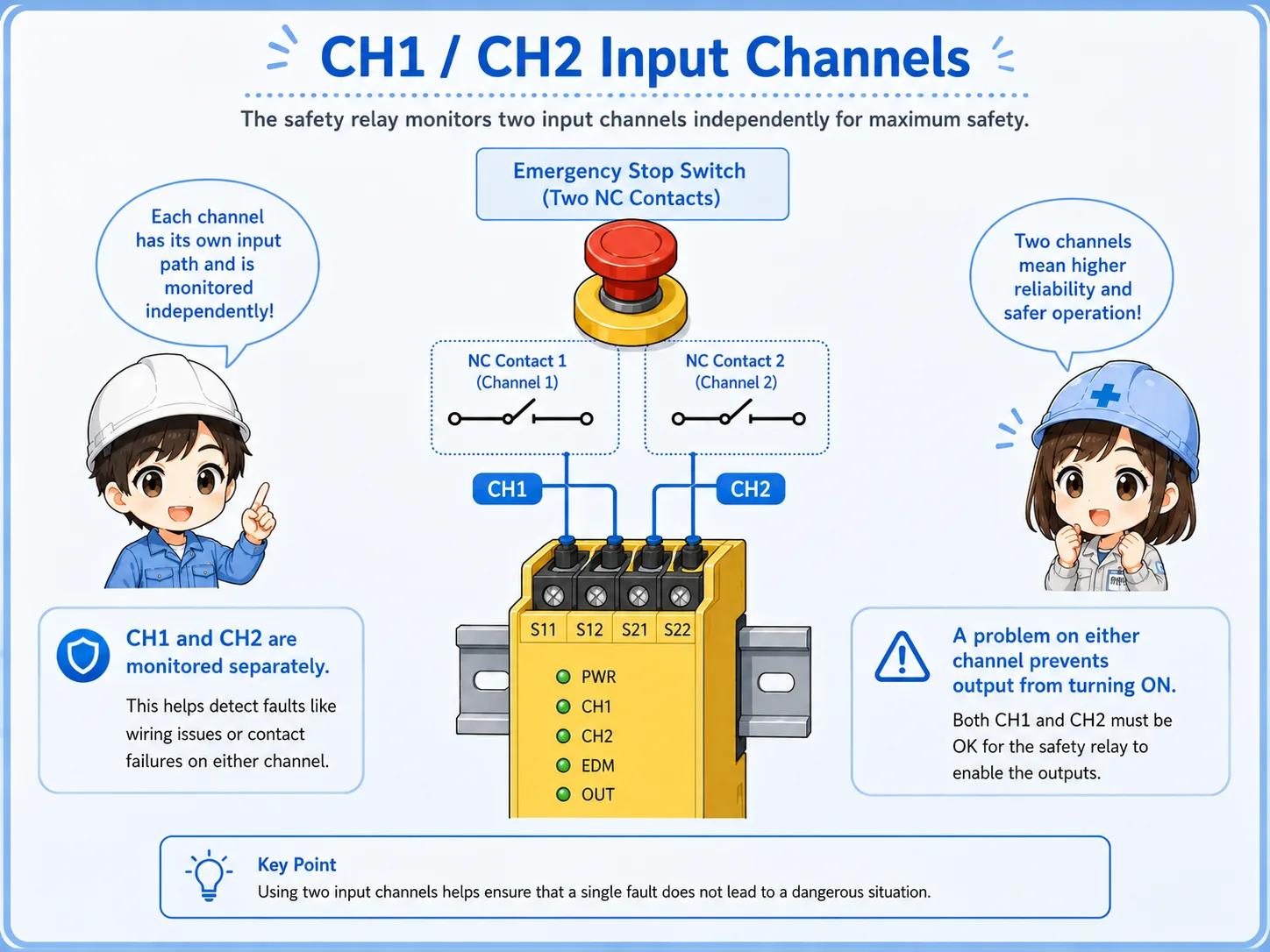
Many safety relays use two input channels, often called CH1 and CH2, to monitor the safety input path more reliably.
In a simple emergency stop circuit, one contact may be connected to CH1 and another contact to CH2. The safety relay checks whether both channels are in the expected state.
If one channel is open, wired incorrectly, shorted, or not synchronized as expected, the safety relay may not turn on its safety outputs even if the operator thinks the switch has been released.
| Item | What to understand | Typical field check |
|---|---|---|
| CH1 | One safety input channel monitored by the safety relay. | Check input LED, terminal voltage, wiring, and contact state. |
| CH2 | The second safety input channel used with CH1. | Check that it changes correctly and is not stuck or open. |
| Input mismatch | The relay may detect that CH1 and CH2 are not behaving as expected. | Check wiring mistakes, contact timing, shorts, and damaged switches. |
Reset and EDM
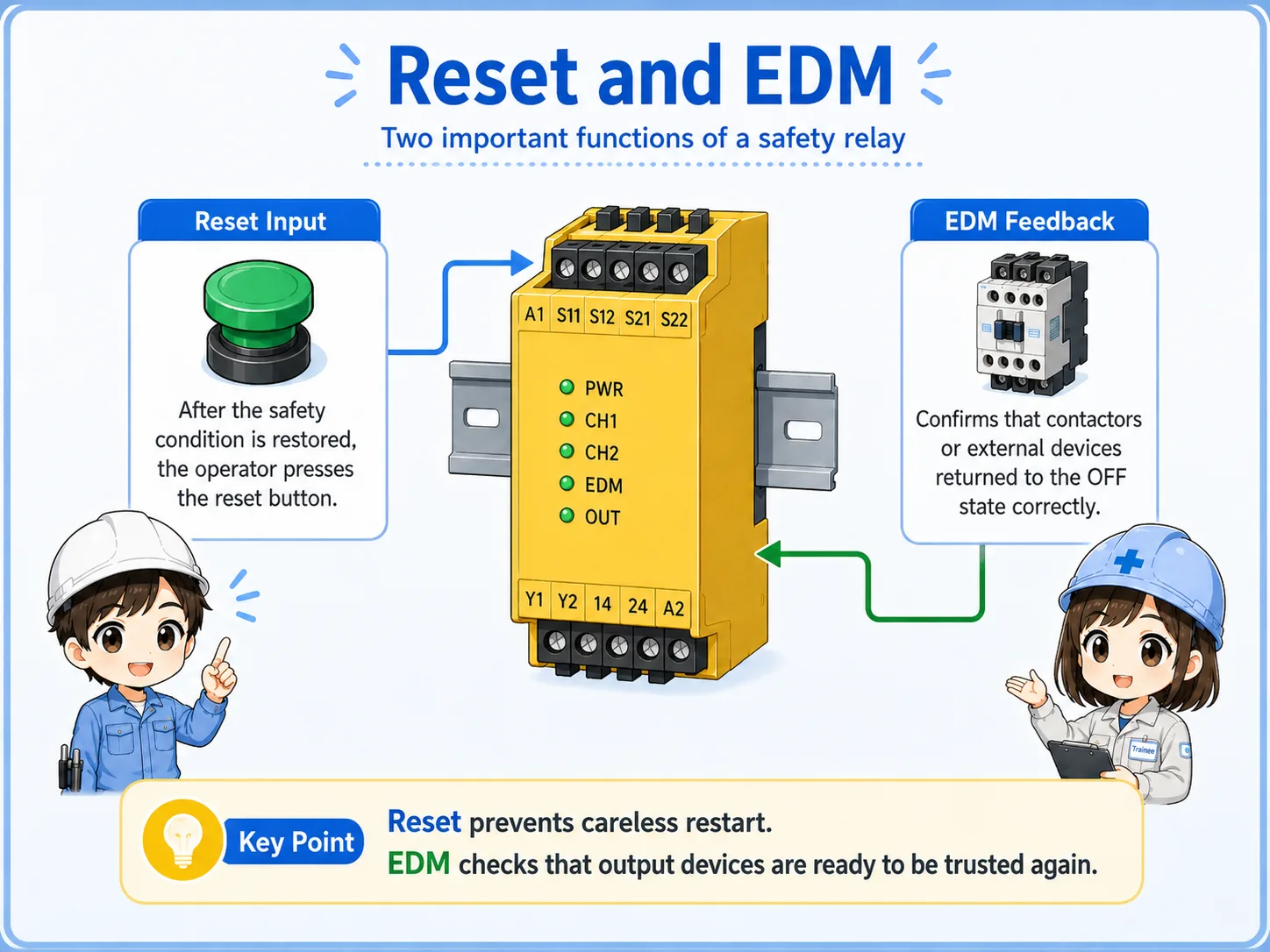
Reset and EDM are important because a safety relay should not restart the machine carelessly after a safety condition returns to normal.
A reset input is often used to restart the safety relay after the emergency stop has been released or the safety door has been closed. Depending on the machine design, the operator may need to press a reset button deliberately.
EDM means external device monitoring. It is used to check whether downstream devices, such as contactors, returned to the expected off state before the safety relay allows restart.
Simple way to remember
Safety input checks whether the dangerous condition is gone. Reset confirms the restart action. EDM checks whether the output devices are ready to be trusted again.
Safety outputs
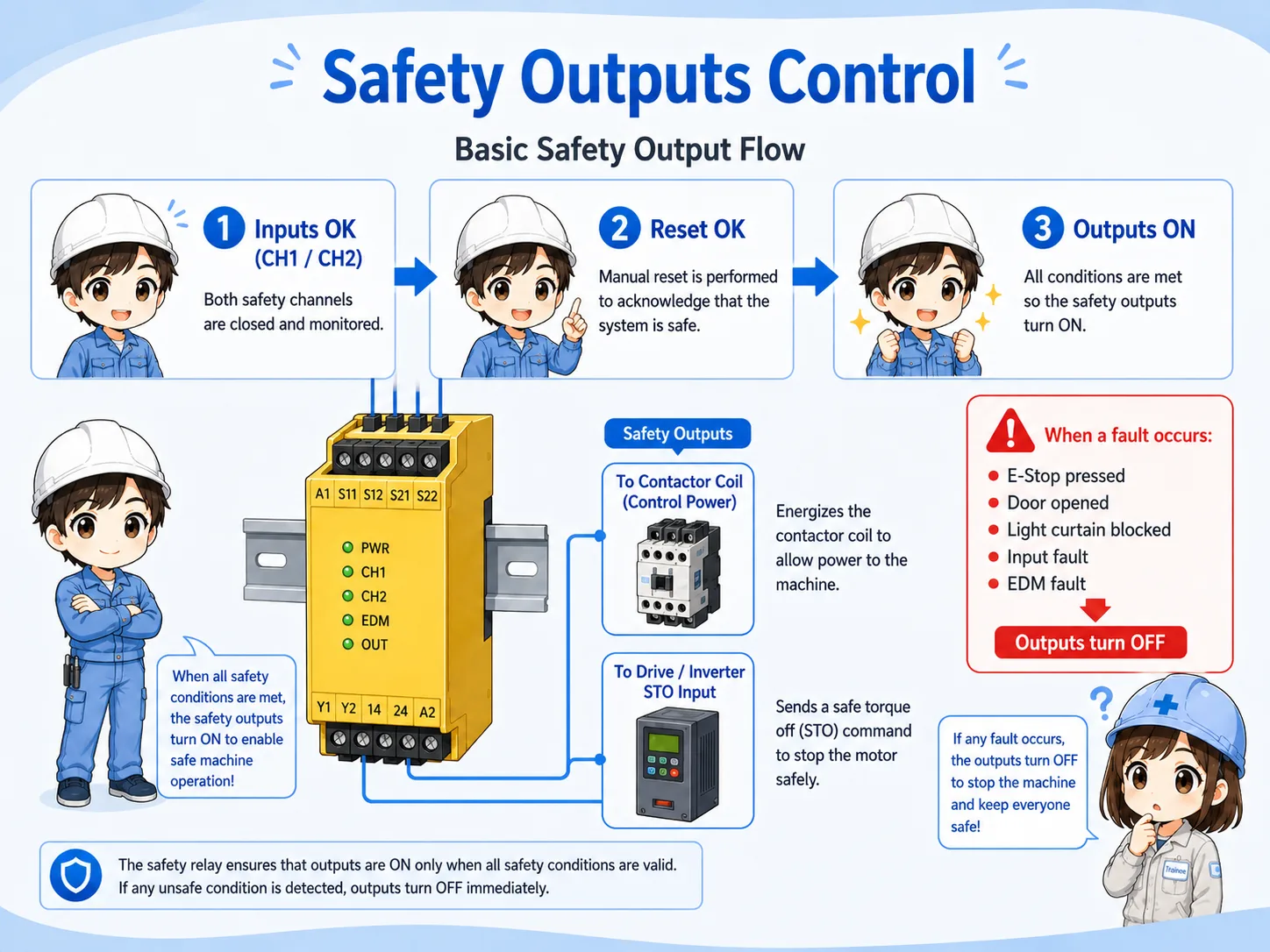
Safety outputs are the contacts or output signals that the safety relay turns on only when the safety conditions are satisfied.
These outputs may control contactor coils, drive enable circuits, machine permission signals, or STO inputs. When the safety relay detects an emergency stop, open door, blocked light curtain, or input fault, these safety outputs turn off.
1. Inputs OK
CH1 and CH2 are in the expected safe state.
2. Reset OK
The reset condition is satisfied according to the circuit design.
3. Outputs ON
The safety relay allows its safety outputs to turn on.
Relation to contactors and STO
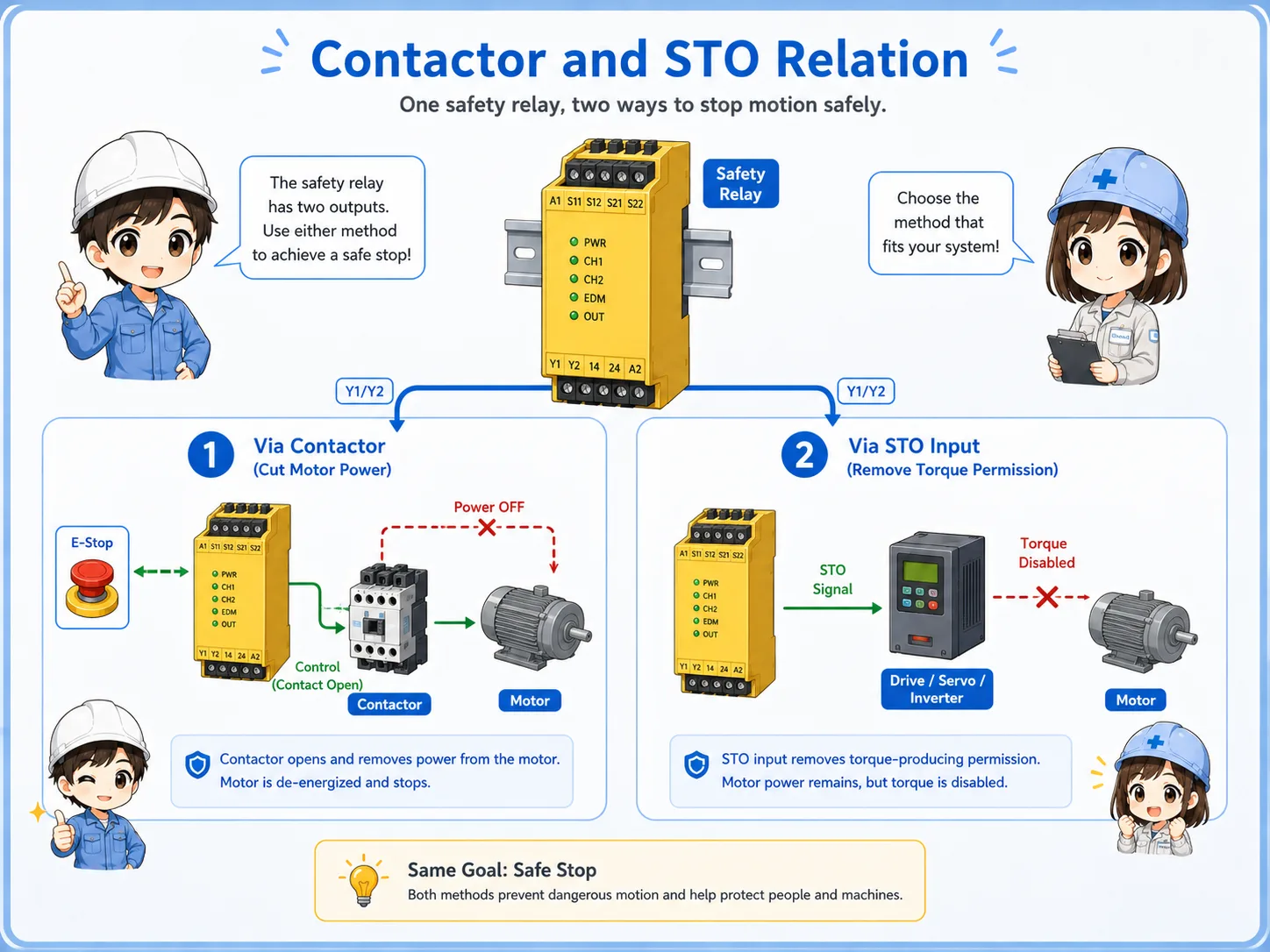
A safety relay often controls the part that actually removes machine operation permission.
In older or simple circuits, the safety relay may remove power from contactor coils. The contactors then open and disconnect power to the motor circuit.
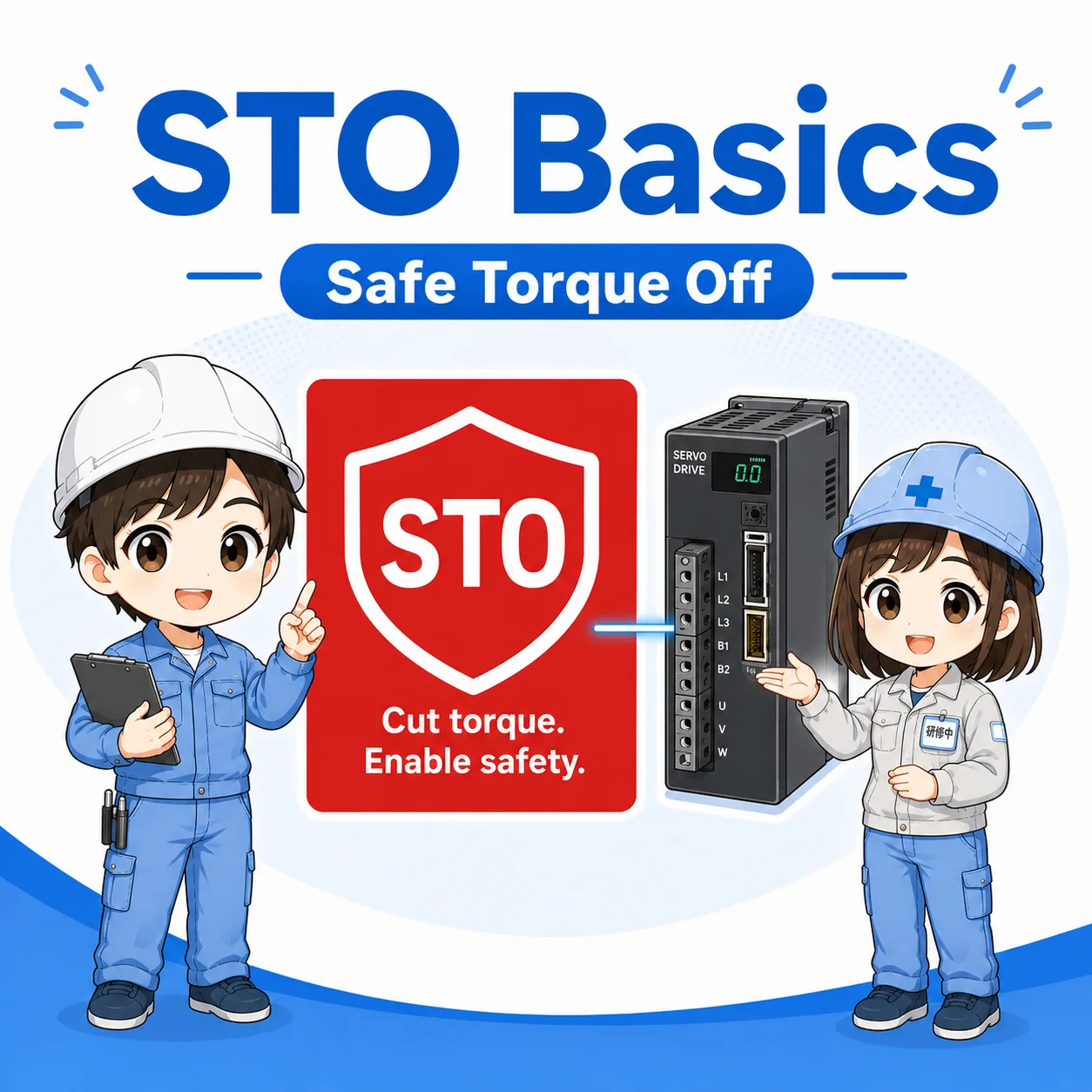
In inverter or servo systems, safety relay outputs may be connected to STO inputs. When the safety relay output turns off, the drive loses torque-producing permission.
The exact method depends on the machine design and the manufacturer’s manual, but the troubleshooting idea is the same: check the safety relay first, then check the downstream output device.
Do not mix up PLC status and safety output
A PLC may show safety status on a screen, but the actual safety action depends on the safety relay, output wiring, contactors, drives, and reset logic.
Field check points
When a safety relay does not turn on, check each condition in order instead of replacing parts immediately.
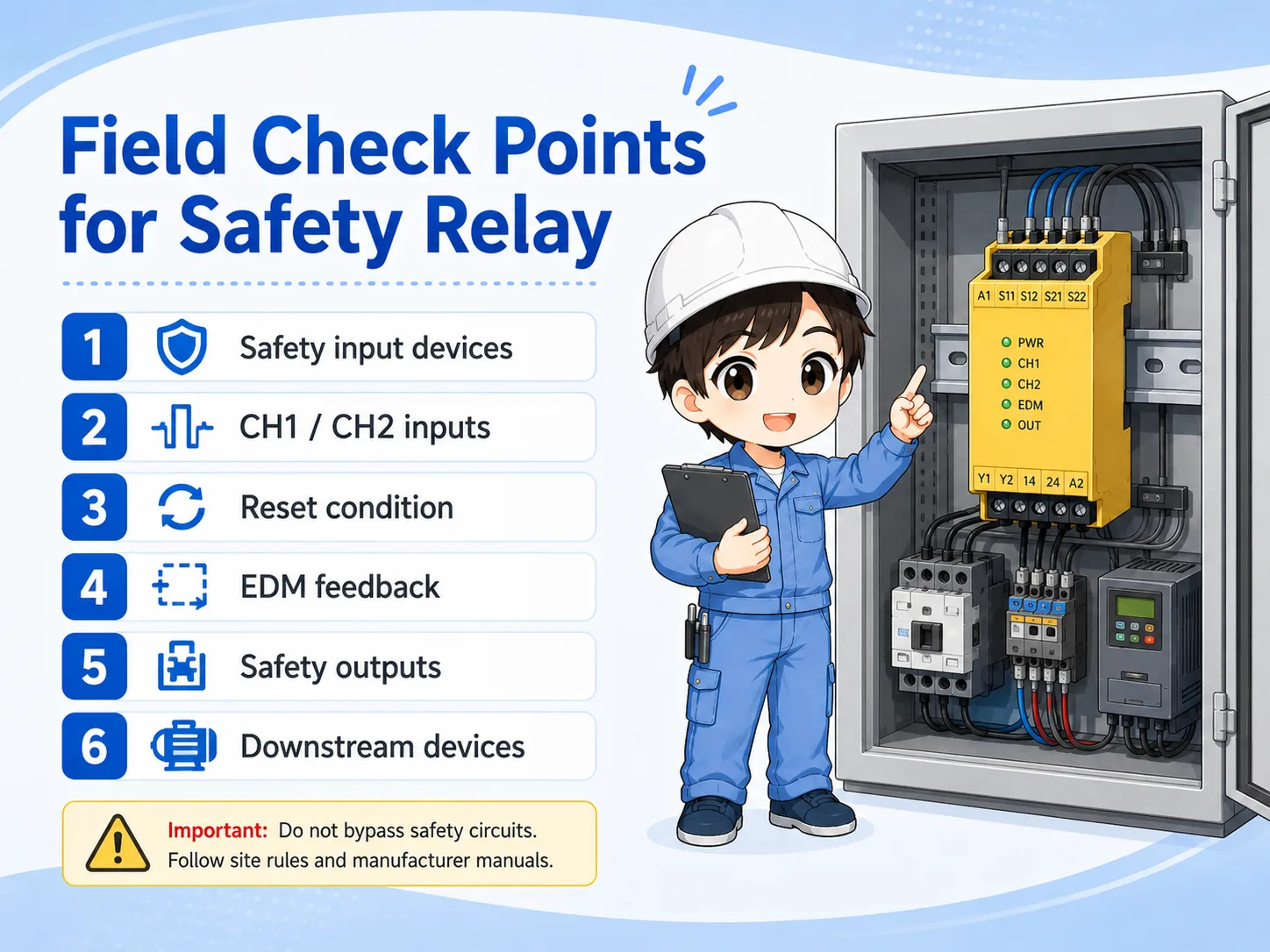
Safety input devices
Check emergency stop switches, safety doors, light curtains, and their contact states.
CH1 and CH2
Confirm that both channels are wired correctly and show the expected input status.
Reset condition
Check whether the circuit requires manual reset and whether the reset input is working.
EDM feedback
Confirm that contactor feedback or external device monitoring returns correctly.
Safety output
Check whether the safety relay output contacts or output signals actually turn on.
Downstream device
Check contactor coils, STO terminals, drive enable inputs, and related alarms.
Do not bypass the safety relay casually
A safety relay is part of a safety-related circuit. Do not short inputs, reset circuits, or safety outputs just to make a machine run. Follow site rules and manufacturer instructions.
Common beginner mistakes
Safety relay troubleshooting becomes confusing when it is treated like an ordinary relay.
- Checking only the PLC screen and ignoring safety relay LEDs.
- Thinking CH1 and CH2 are just duplicate wires with no diagnostic meaning.
- Forgetting that reset may be required after the safety condition is restored.
- Ignoring EDM feedback from contactors or other external devices.
- Assuming the safety relay output is on because the emergency stop is released.
- Bypassing safety inputs during troubleshooting without proper procedure.
Safety relay behavior depends on the exact model
Terminal names, LED meanings, reset wiring, EDM wiring, and output types vary by manufacturer and model. Use this article as a basic concept guide, then check the actual manual.
Short conversation

If the machine will not reset, do not check only the emergency stop button. Look at the safety relay LEDs too.

So CH1 and CH2, reset, and EDM can each prevent the safety output from turning on?
Exactly. A safety relay is not just an on/off relay. It checks the safety input path and the restart conditions.
And the output may go to contactors or STO inputs depending on the machine?
Yes. That is why you check the input side, reset side, EDM side, and output side separately.
Summary
A safety relay monitors safety input devices such as emergency stop switches, safety door switches, and light curtains. If the safety condition is not satisfied, it turns off safety outputs that may control contactors, drive enables, or STO inputs.
When troubleshooting, separate the check into CH1/CH2 inputs, reset, EDM, safety outputs, and downstream devices. This makes the problem easier to follow without treating the safety relay like an ordinary relay.