Good fit for
- Beginners who see air cylinders on machines but are unsure how they move
- Electricians learning pneumatic devices around PLC-controlled equipment
- People who want to connect air valves, cylinders, and reed switches in their mind
An air cylinder is a pneumatic actuator that moves a rod forward and back using compressed air. This guide explains the basic structure, motion flow, air valve relationship, reed switch role, and field checkpoints.
An air cylinder is a device that uses compressed air to create straight-line motion.
In factory automation and control equipment, an air cylinder, also called a pneumatic cylinder or pneumatic actuator, is often used to push, pull, lift, clamp, slide, stop, press, or position a mechanical part. The actual bore size, stroke, force, mounting method, and sensor options depend on the cylinder specification and machine design.
The basic idea is simple: compressed air enters the cylinder, pressure acts on the piston, and the rod moves. When air is switched to the other side, the rod returns or moves in the opposite direction.
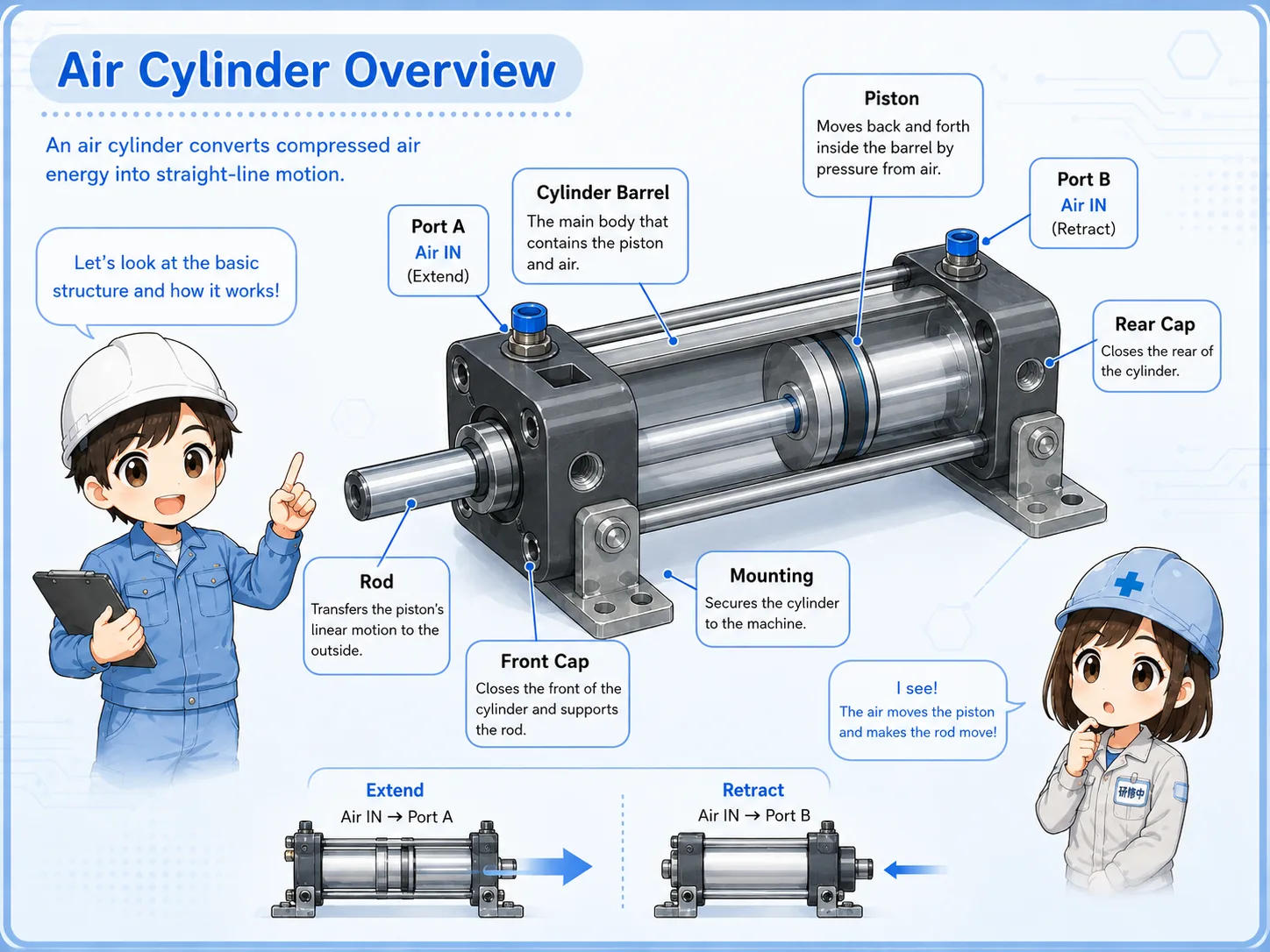
Think of the air cylinder as the part that physically moves. The PLC and air valve decide when it moves, but the cylinder is the actuator doing the mechanical work.
Most beginner confusion disappears once you separate air flow, cylinder movement, and position detection.
For a typical double-acting air cylinder, compressed air is sent to one side of the piston to move the rod forward. To return it, the air path is switched so compressed air is sent to the other side.
The exact words used on site may be “advance,” “extend,” “forward,” “retract,” “return,” or similar expressions depending on the machine and drawing.
Compressed air reaches one side of the cylinder through piping.
Pressure pushes the piston and the rod moves in a straight line.
A reed switch or sensor may confirm the forward or return end.
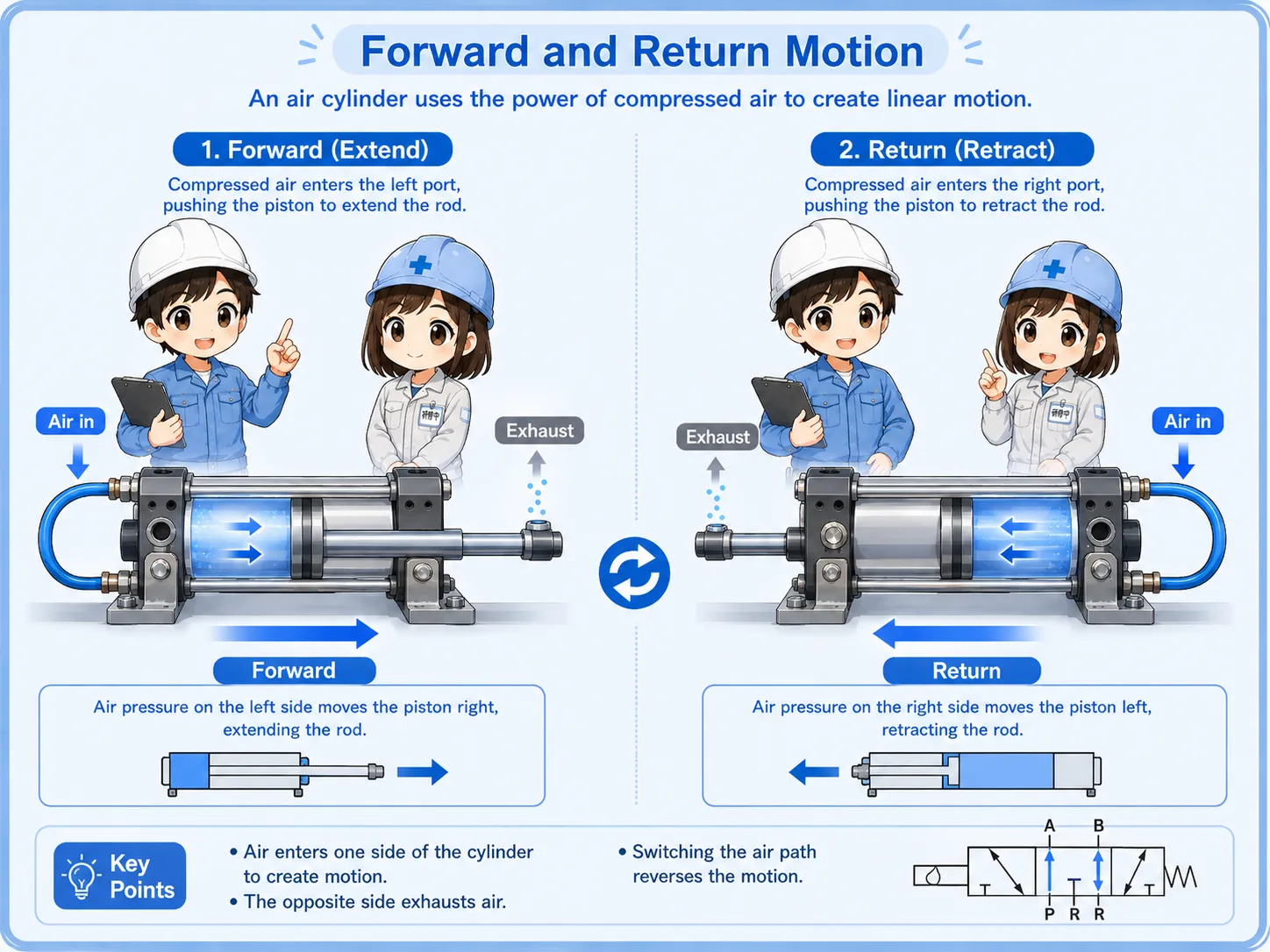
The cylinder itself does not usually decide when to move. The air valve switches the air flow.
An air valve, often a solenoid valve in automated equipment, changes which port receives compressed air and which side is exhausted. That is why a cylinder problem is often checked together with the air valve.
From an electrical-control viewpoint, the PLC output may energize a solenoid valve coil. The valve then changes the pneumatic air path, and the cylinder moves.
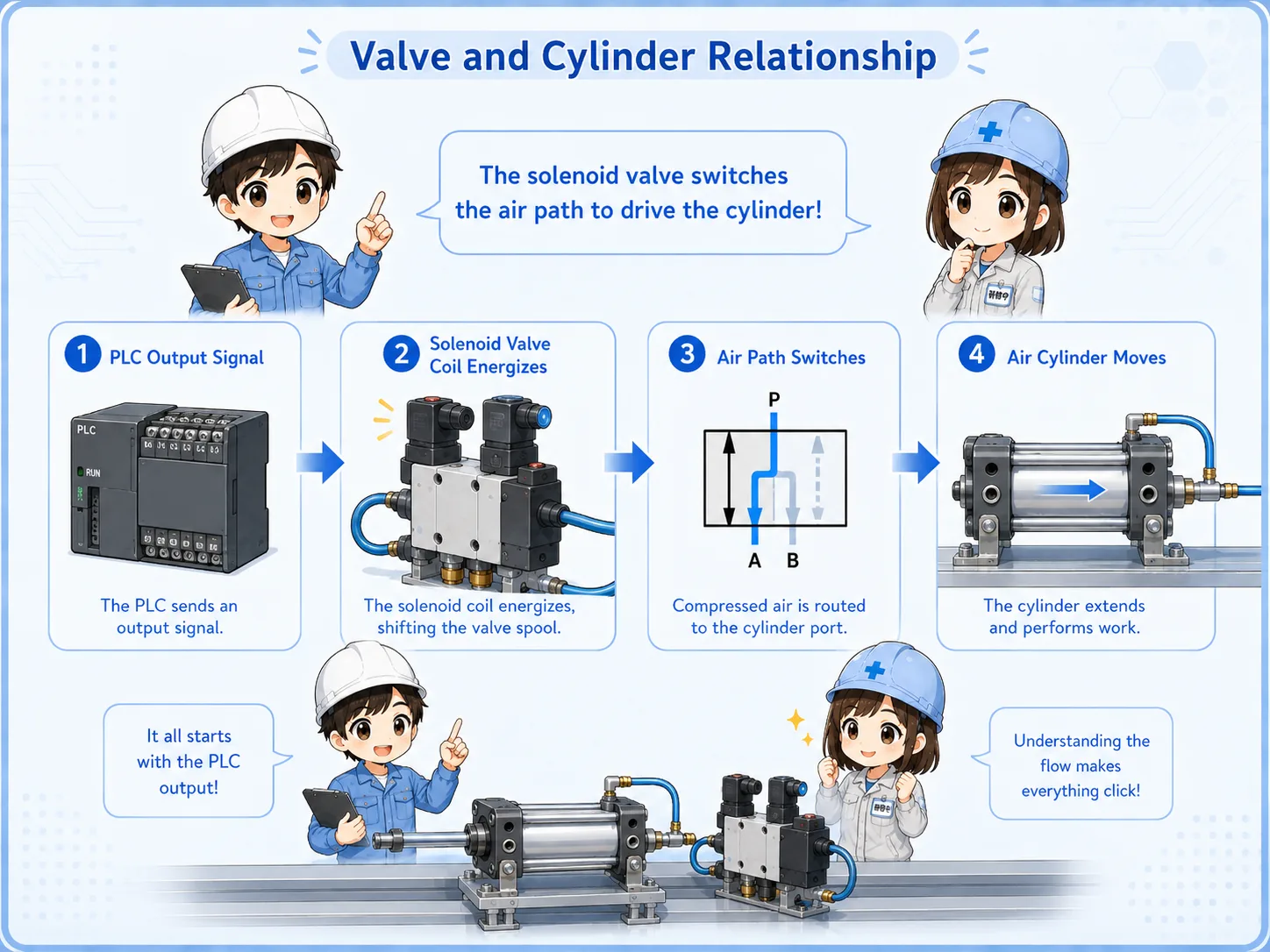
When a cylinder does not move, do not look at the cylinder alone. Check air supply, valve operation, wiring to the valve, manual override, piping, speed controllers, and mechanical load.
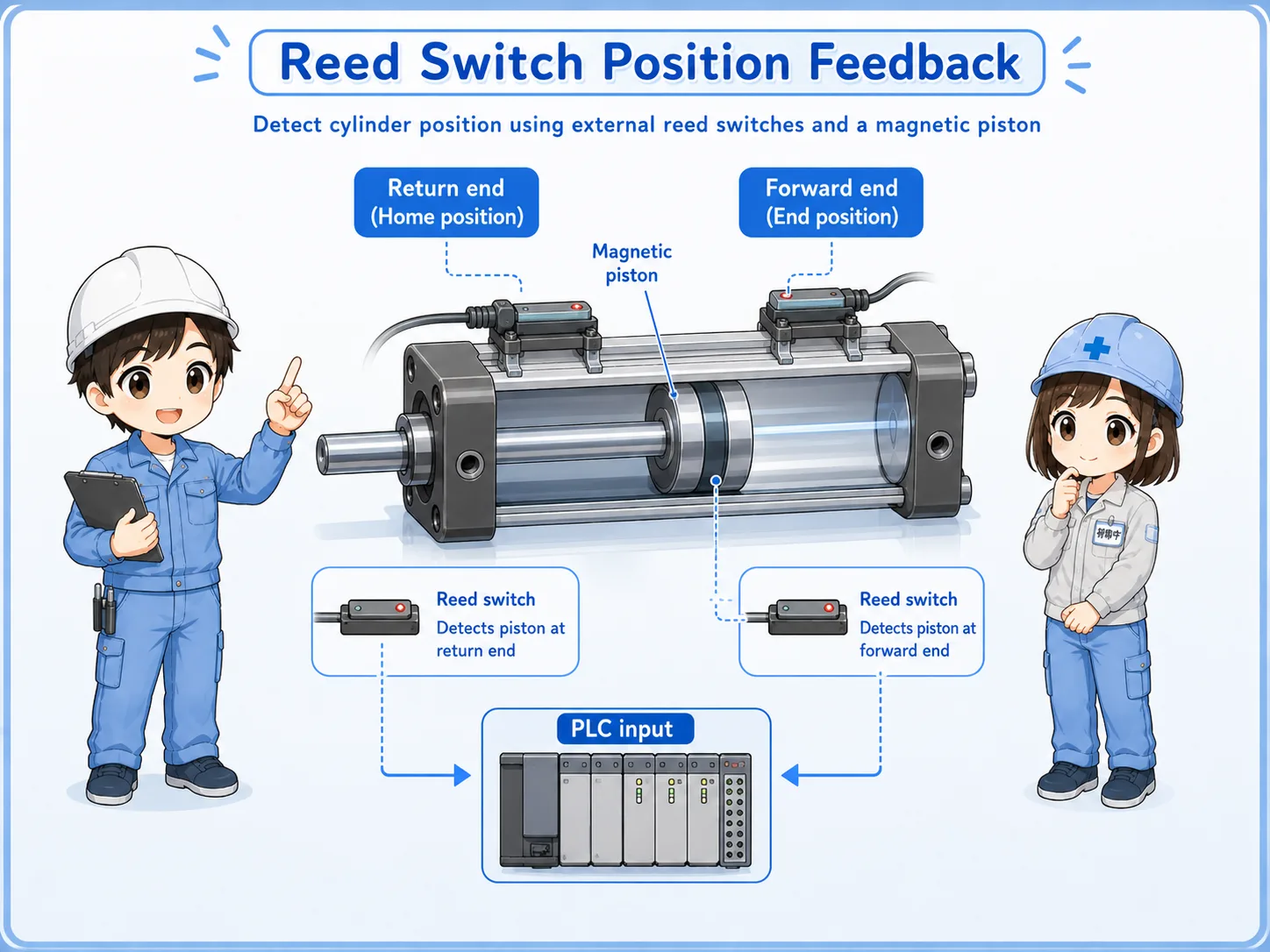
A reed switch or cylinder sensor often tells the PLC whether the cylinder reached a position.
Many air cylinders have magnetic pistons and external reed switches. When the piston reaches the switch location, the sensor turns ON. This signal can be wired to a PLC input.
Typical examples are forward-end confirmation and return-end confirmation. The PLC can use those signals to decide whether the next step is allowed.
| Part | Main role | Electrical-control viewpoint |
|---|---|---|
| Air cylinder | Moves mechanically using compressed air | Actuator side |
| Air valve | Switches the air path | Often controlled by PLC output |
| Reed switch | Detects cylinder position | Often wired to PLC input |
A short conversation helps connect pneumatic movement with electrical signals.

When an air cylinder does not move, do not jump straight to “the PLC is wrong.” First split the system into air, valve, cylinder, sensor, and program.

So I should check whether the valve is switching air, whether the cylinder can physically move, and whether the reed switch is reporting the position?
Exactly. The PLC output, solenoid valve, air path, cylinder movement, and PLC input feedback are connected as one chain.
Troubleshooting becomes easier when you follow the motion chain in order.
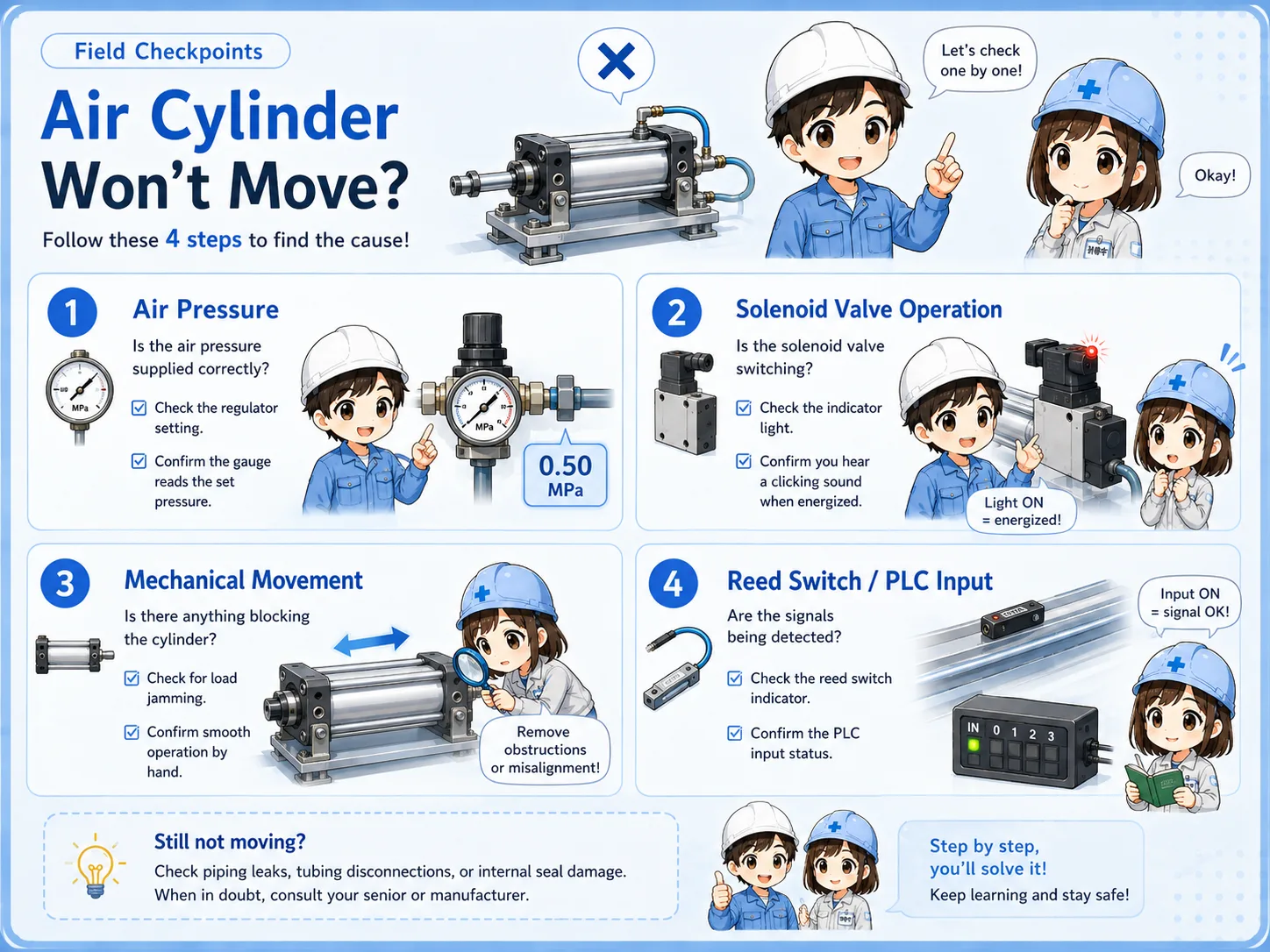
Check supply pressure, regulator setting, shutoff valve, filter condition, and whether air is reaching the valve.
Check PLC output, valve coil, connector, manual override, and whether the valve is actually switching.
Look for mechanical interference, load problems, speed controller settings, exhaust restriction, air leaks, bent rods, or stuck sliding parts. Do not simply raise air pressure to force motion; check the air path, valve switching, mechanical load, and safety area according to the pneumatic circuit drawing and machine safety procedure.
Check reed switch position, sensor LED, PLC input status, cable condition, and whether the switch is adjusted correctly.
Air cylinders can move suddenly when air or signals are restored. Follow machine safety procedures, release stored energy when required, and never put your hands into a moving area.
These articles help connect air cylinders with nearby control devices.