
What is a reed switch?
A reed switch is a magnetic switch. In machine control, it is often used to detect the position of an air cylinder.
Inside an air cylinder, the piston may contain a magnet. When the piston moves close to the reed switch, the magnetic field makes the switch output turn on. The PLC can then read that signal as “the cylinder has reached this position.”
In practice, a reed switch is often used for advance-end confirmation and return-end confirmation. These signals help the PLC decide whether the next step of the machine sequence can start.
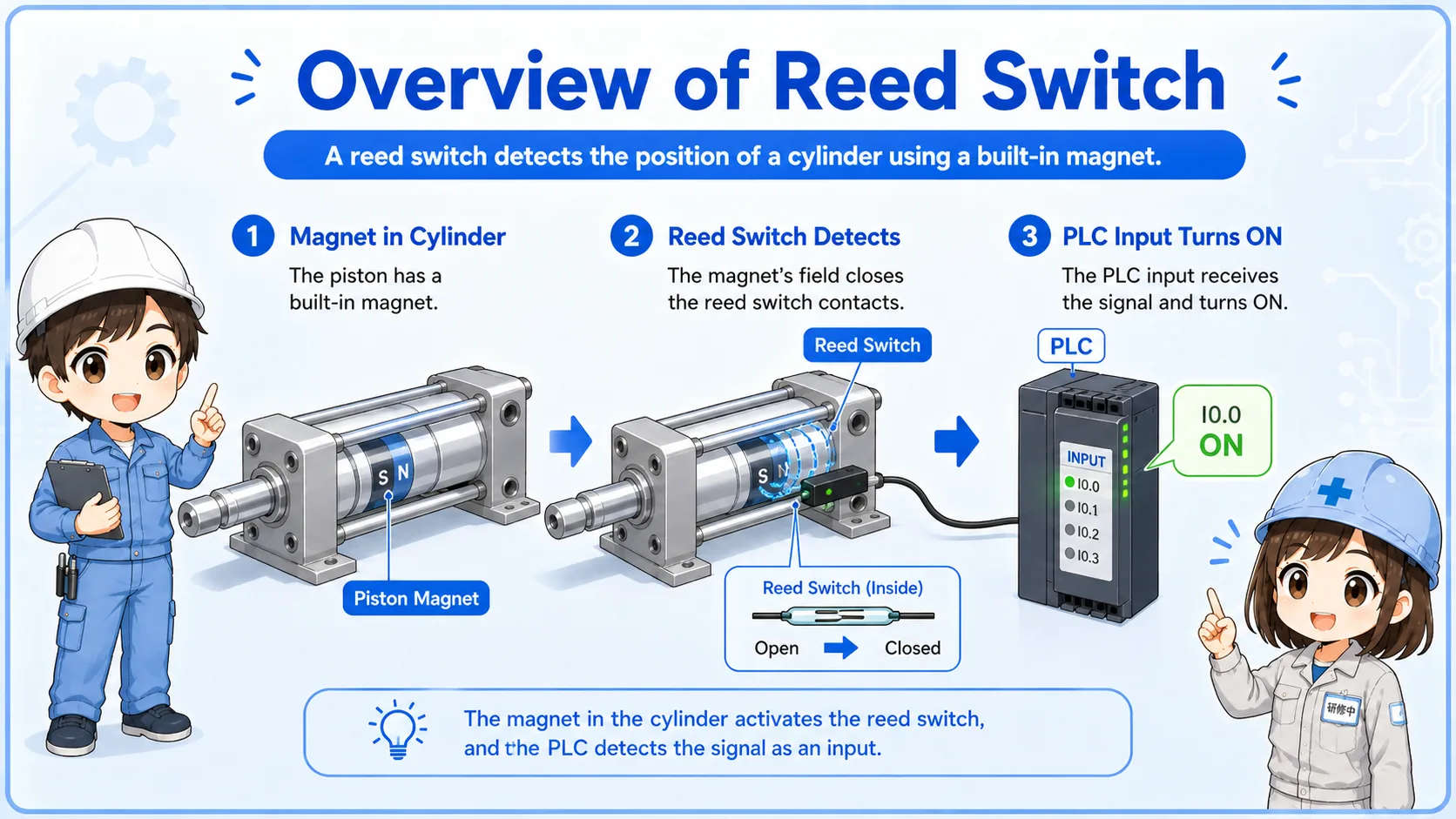
How a reed switch relates to an air cylinder
The reed switch does not move the cylinder. It only confirms the cylinder position.
The air valve changes the air path and moves the cylinder. The reed switch is mounted on the cylinder body and detects where the piston is. These two parts are often checked together, but their roles are different.
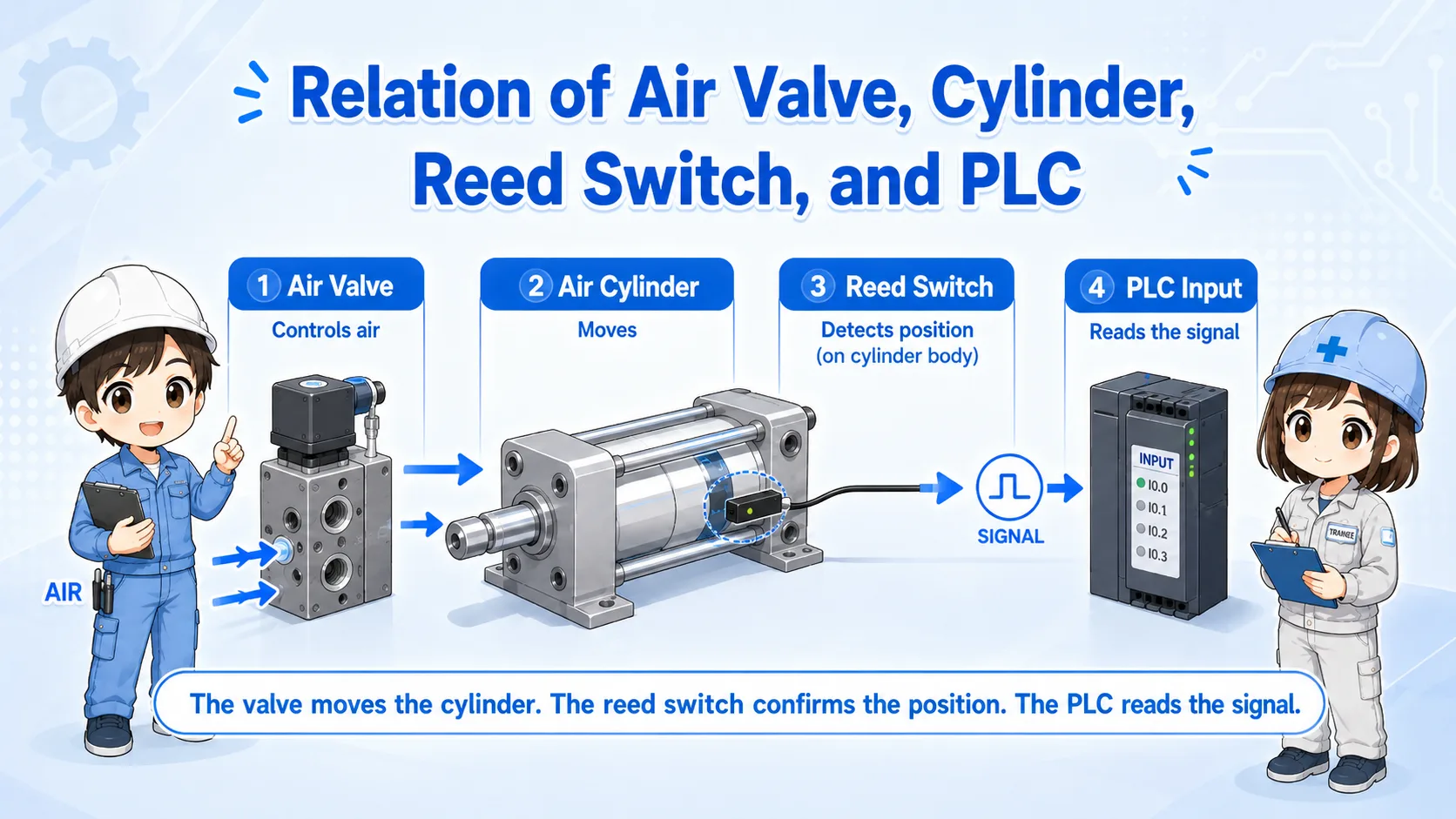
| Part | Basic role | Common field check |
|---|---|---|
| Air valve | Switches the air path and moves the cylinder. | Check valve output, manual override, air supply, and coil voltage. |
| Air cylinder | Physically extends and retracts by compressed air. | Check smooth motion, speed controller, mechanical load, and stroke end. |
| Reed switch | Detects the cylinder piston position and outputs a signal. | Check LED, mounting position, wiring, and PLC input status. |
How the reed switch signal reaches the PLC
A reed switch is usually wired to a PLC input terminal, so the program can see whether the cylinder has reached a position.
When the reed switch turns on, the PLC input also turns on. In the ladder program, this input may be used as an advance-end signal, return-end signal, interlock condition, or step-completion condition.
1. Cylinder moves
The piston moves forward or backward inside the cylinder.
2. Reed switch turns on
The switch detects the piston magnet near the mounting point.
3. PLC input changes
The PLC reads the input and the sequence can continue.
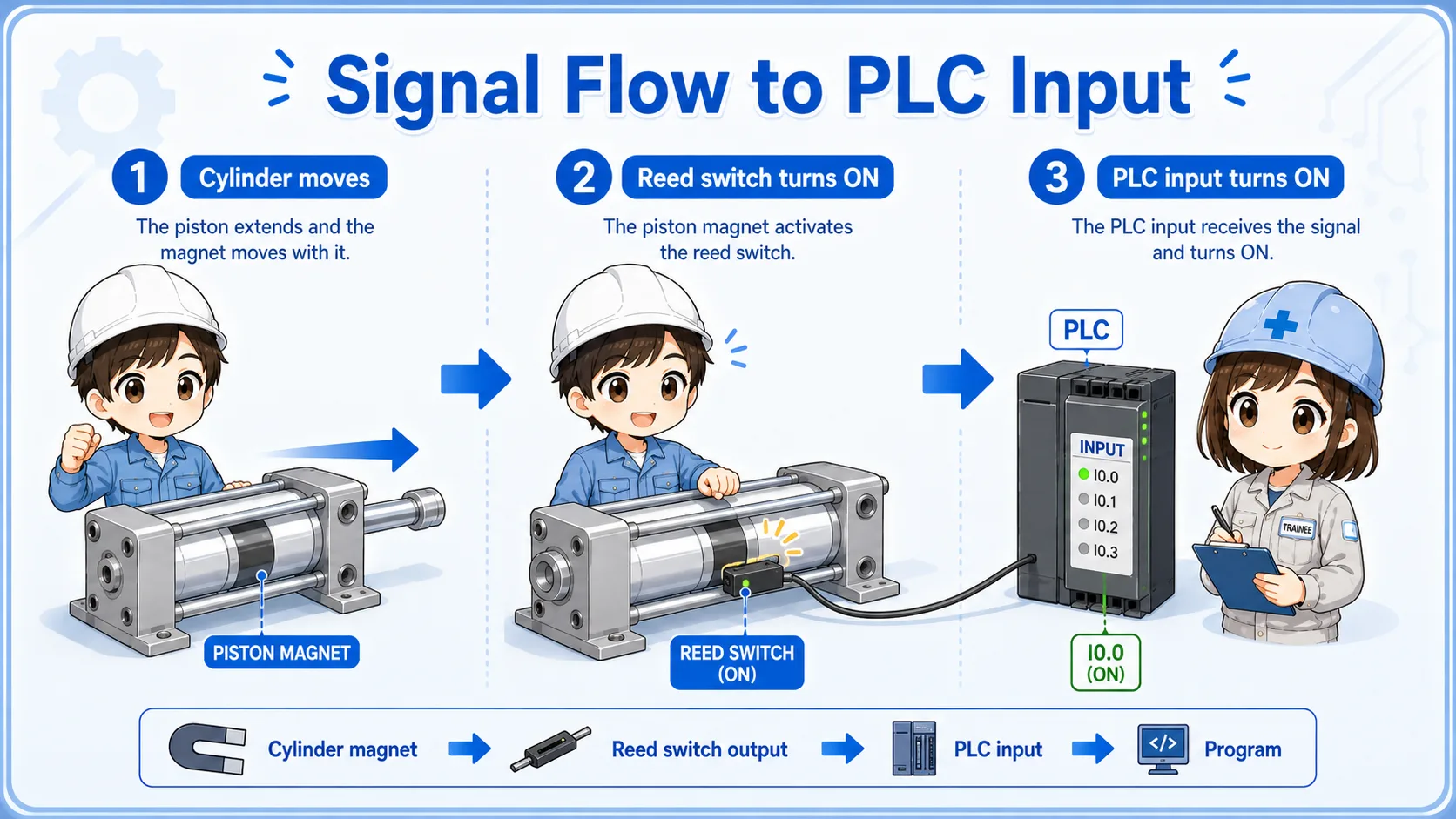
Check both the sensor LED and the PLC input
If the reed switch LED turns on but the PLC input does not, the issue may be wiring, input common, input type, or PLC terminal assignment.
Mounting position matters
A reed switch may not turn on if it is mounted slightly away from the correct detection position.
In the field, the switch position is often adjusted along the cylinder groove. If the position is too far from the piston magnet, the switch may not turn on. If it is too close to a borderline position, the signal may flicker.
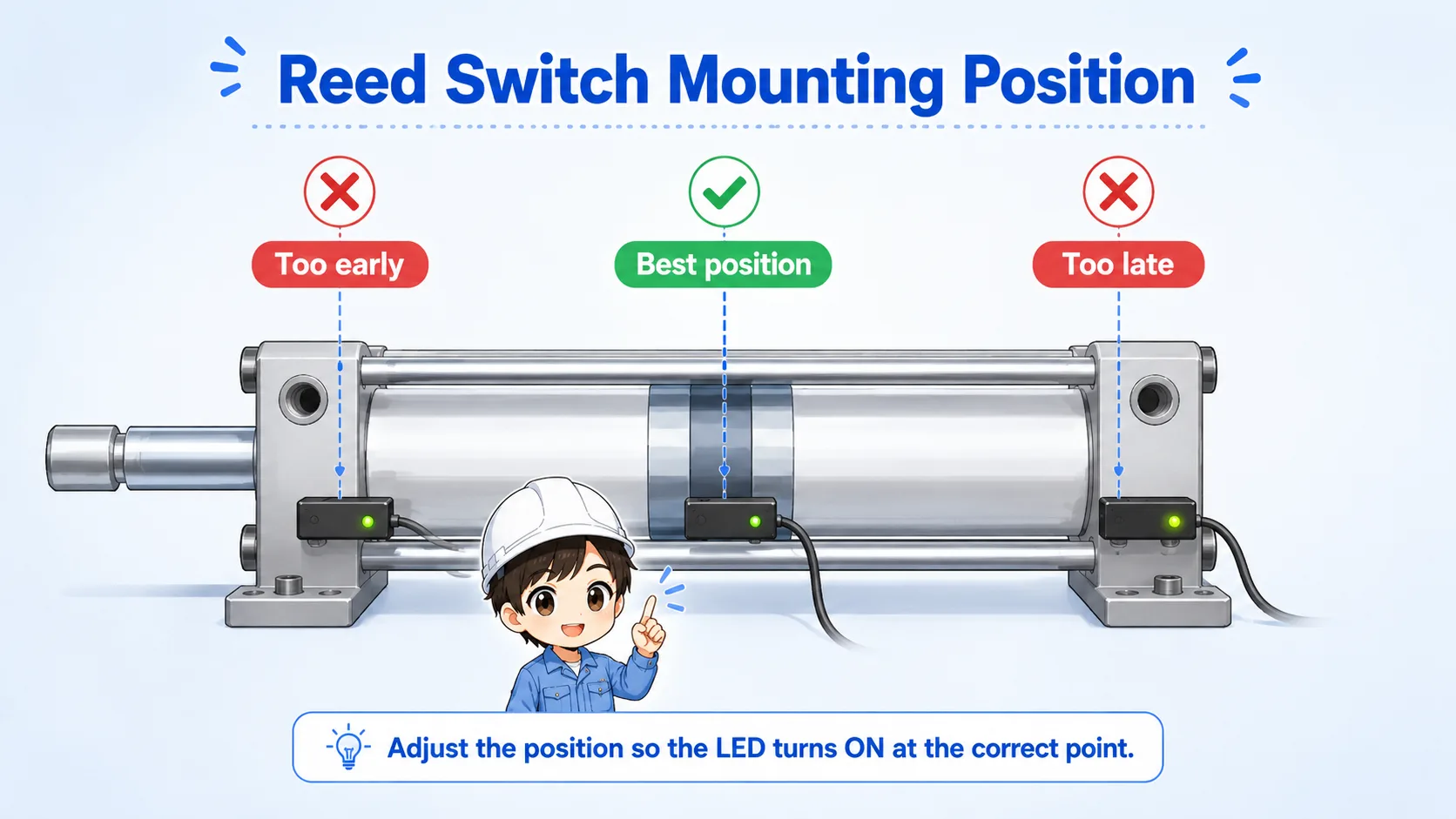
Do not assume the switch is broken too early
If the LED does not turn on, first check whether the cylinder actually reaches the position and whether the switch is mounted at the correct point.
When the reed switch signal does not turn on
Separate the problem into cylinder motion, sensor detection, wiring, and PLC input status.
A common mistake is to check only the ladder program. For reed switch problems, the physical cylinder position and sensor LED are just as important as the PLC input address.
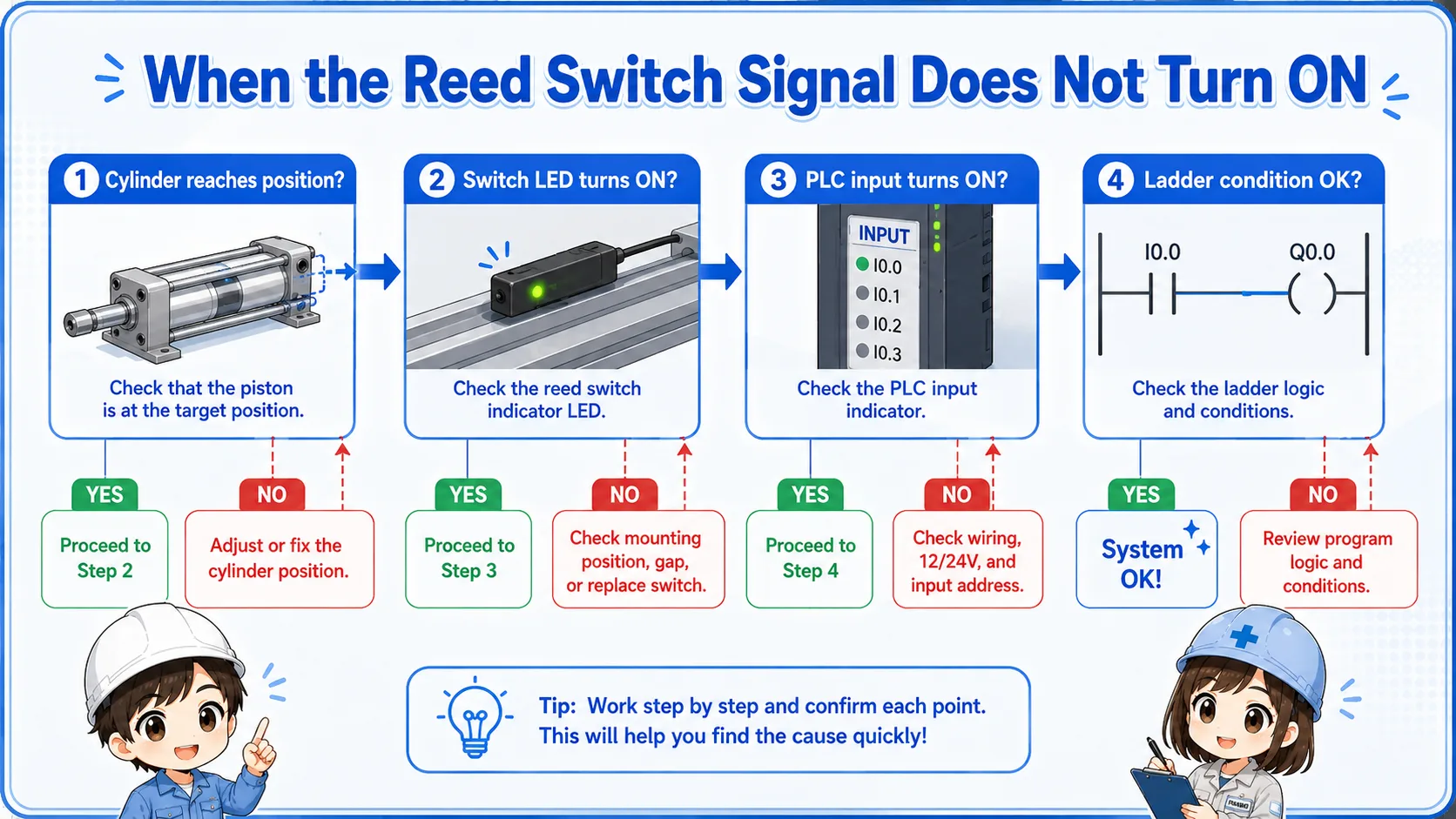
Cylinder reaches the position?
If the cylinder does not fully reach the end, the switch may never detect the magnet.
Switch LED turns on?
If the LED does not turn on, check mounting position, magnet, and sensor power.
PLC input turns on?
If the LED is on but PLC input is off, check wiring, common, and input terminal.
Ladder condition allows it?
If the input is on but the sequence does not move, check interlocks and step logic.
Field check points
A reed switch is small, but it often decides whether the machine sequence can continue.

Practical field order
First look at the actual cylinder motion. Then check the reed switch LED. After that, confirm the PLC input monitor and ladder condition.
- Confirm the cylinder actually reaches the expected position.
- Watch the reed switch LED while moving the cylinder slowly.
- Check whether the PLC input monitor changes at the same time.
- Check sensor mounting screws and cable damage.
- Check whether the input address matches the drawing and ladder program.
Short conversation

A reed switch does not move the cylinder. It confirms the cylinder position.

So if the cylinder moves but the next step does not start, I should check the reed switch signal?
Yes. Check the switch LED, PLC input monitor, and whether the switch is mounted at the correct position.
If the LED turns on but the PLC input does not, the sensor itself may not be the problem?
Exactly. Then check wiring, common, input terminal, and the drawing before replacing the switch.
Summary
A reed switch is a magnetic position detection switch often used with air cylinders. It detects the piston magnet and sends a signal to the PLC input.
When troubleshooting, do not check only the ladder program. Confirm the actual cylinder motion, reed switch LED, mounting position, wiring, PLC input monitor, and ladder condition in order.