What is a fuse holder?
A fuse holder is a part that holds a fuse and connects it into a control circuit.
In a control panel, not every small control circuit should be connected directly to the power source without protection. A fuse holder holds a fuse so that a branch circuit can be protected when an overcurrent or short circuit occurs.
Fuse holders are often used around DC 24V branches, AC control circuits, lamps, relays, sensors, solenoids, and small panel devices. The fuse is the part that melts or opens. The holder is the part that mounts, connects, and allows the fuse to be replaced.
The basic idea
A fuse holder is not only a place to put a fuse. It is part of the protected power path for a small control circuit branch.

When you see a fuse holder, think about what branch it is protecting, not only whether the fuse looks blown.

So if the fuse is blown, I should check what is connected after it?
Exactly. A blown fuse is often a result. The cause may be on the load side.
Why small control circuits need protection
Small branches can still fail, short, or overload. Protection helps limit damage to the affected branch.
A control panel may have one power supply feeding many small circuits. If every branch is connected without protection, one short circuit can affect a wider area than necessary. Fuse holders help divide the power path into protected branches.
Branch protection
A fuse can protect one small branch instead of letting a fault spread through the whole control power line.
Easier troubleshooting
If one fuse is blown, the related branch can be traced from that fuse holder.
Device protection
Small devices such as lamps, sensors, and relays may need suitable branch protection.
Fault indication
A blown fuse tells you that something abnormal may have happened on that circuit.
Power branch flow through a fuse holder
A fuse holder is usually placed between the power source and a small control circuit branch.
A typical flow is: power source, fuse holder, branch wiring, and then the connected load. The load may be a relay coil, lamp, sensor, PLC input circuit, solenoid valve, or another panel device.
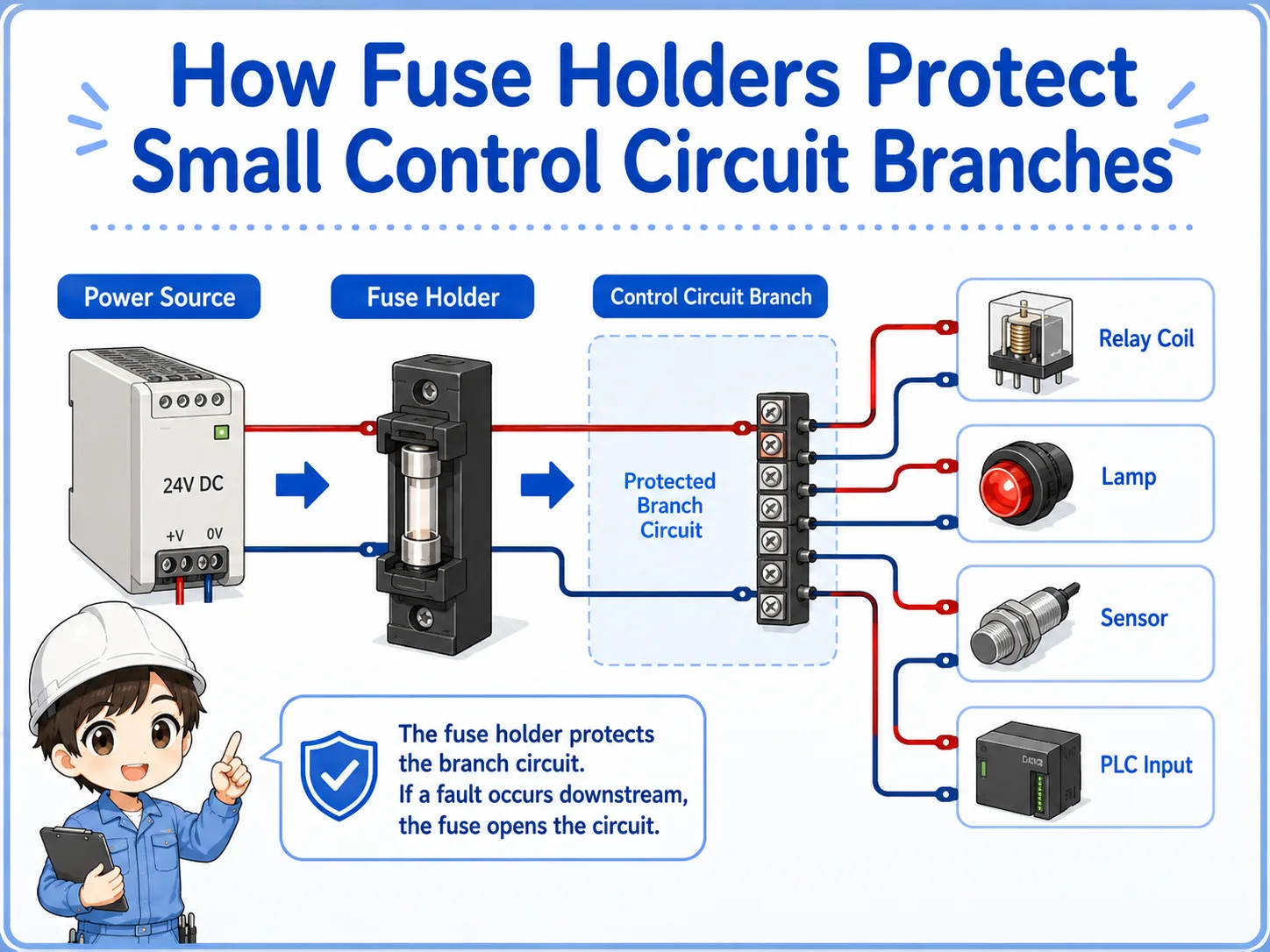
1. Power source
DC 24V or AC control power is supplied.
2. Fuse holder
The fuse is inserted into the branch path.
3. Terminal block
The branch may pass through terminal blocks.
4. Load wiring
Power goes to the connected device or circuit.
5. Device side
A relay, lamp, sensor, or PLC circuit operates.
Field-friendly view
When one branch has no power, trace from the power source to the fuse holder, then from the fuse holder to the load side.
Fuse holder vs circuit protector
A fuse holder uses a replaceable fuse. A circuit protector is usually reset after tripping, depending on the type.
Both are used to protect circuits, but their handling is different. With a fuse holder, the fuse element opens and usually needs replacement. With a circuit protector, the device may trip and then be reset after the cause is corrected.
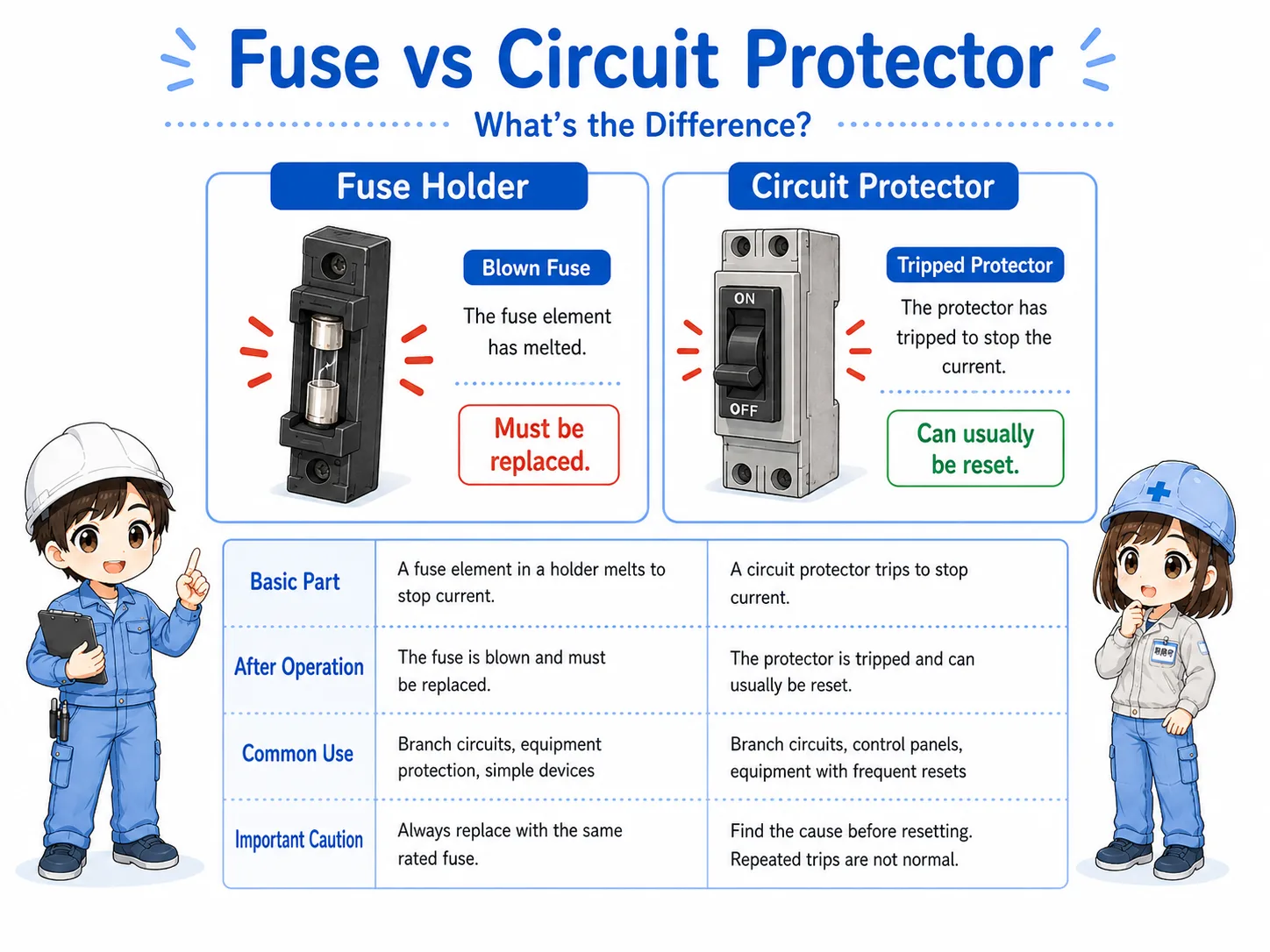
| Item | Fuse holder | Circuit protector |
|---|---|---|
| Basic part | Holder plus replaceable fuse. | Protective device with trip and reset mechanism. |
| After operation | The blown fuse usually needs replacement. | The device may be reset after checking the cause. |
| Common use | Small branch circuits, control power branches, panel devices. | Control circuits or equipment branches where resettable protection is useful. |
| Important caution | Do not replace with a larger fuse just to stop it from blowing. | Do not keep resetting without finding the fault cause. |
Simple rule
A fuse blowing or a circuit protector tripping is a warning sign. Always look for the reason before restoring the circuit.
Field check points when a fuse is blown
Before replacing a fuse, check the power source, fuse rating, holder condition, terminals, and load side.
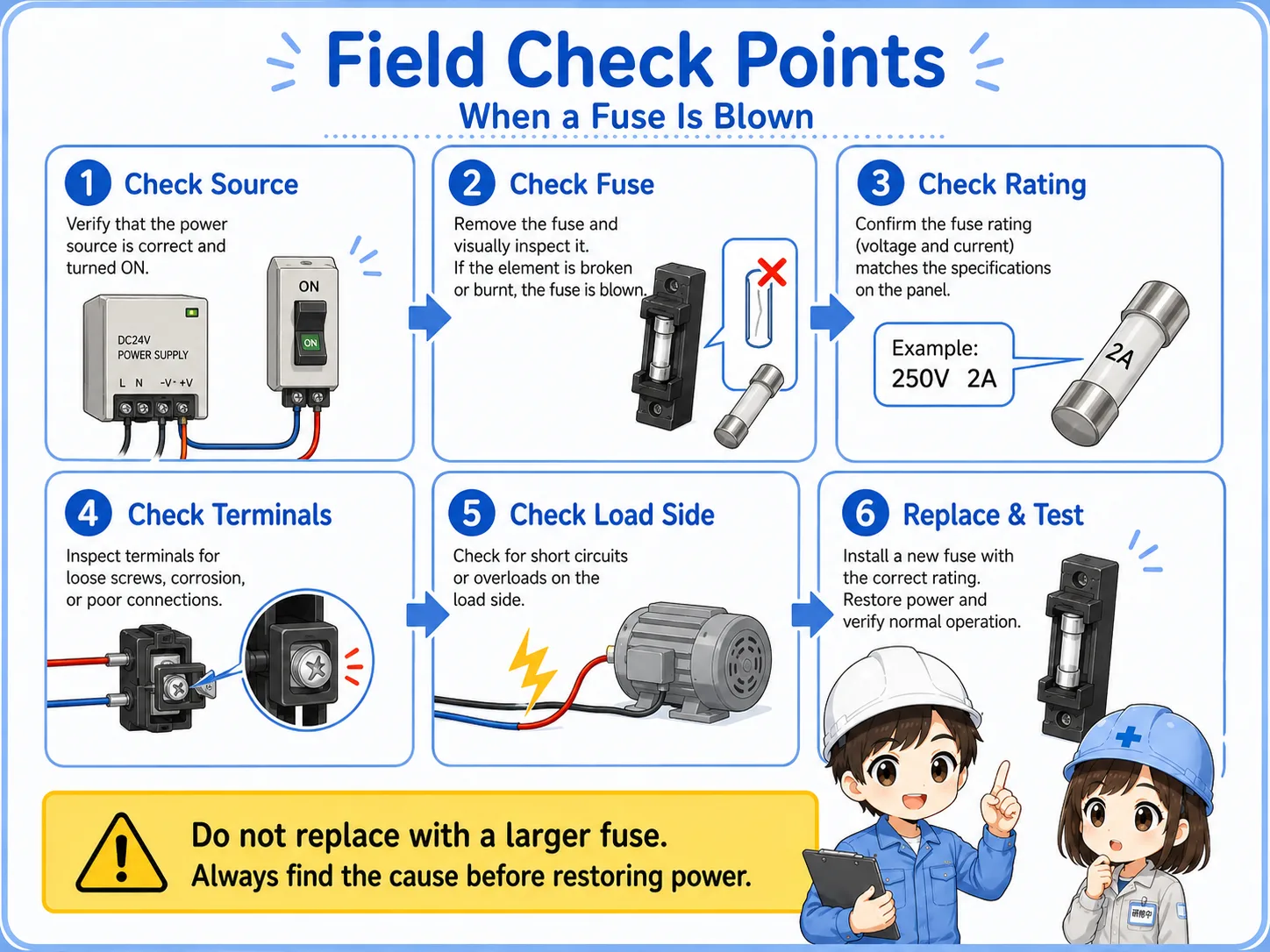
Source voltage
Check whether power is present before the fuse holder.
Fuse condition
Check whether the fuse is open, blown, loose, or incorrectly installed.
Correct rating
Confirm voltage rating, current rating, and fuse type according to the drawing and part specification.
Load-side short
Check downstream wiring and devices before replacing the fuse and restoring power.
Do not simply install a larger fuse
Increasing the fuse rating without confirming the design can remove protection and create a dangerous condition.
Common mistakes with fuse holders
Many problems come from replacing the fuse without finding the cause, using the wrong rating, or missing loose terminals.
| Mistake | Why it causes trouble | Better check |
|---|---|---|
| Replacing only the fuse | The same fault may blow the new fuse again. | Check the load side, wiring, and connected device before restoring power. |
| Using the wrong fuse rating | The circuit may not be protected correctly. | Use the drawing, label, and specification to confirm the correct fuse. |
| Ignoring terminal looseness | Poor contact can cause heat, voltage drop, or intermittent failure. | Check the holder, terminals, and wiring condition when safe and allowed. |
| Forgetting restart behavior | Restoring control power may cause equipment to operate or alarms to clear unexpectedly. | Confirm the machine state before replacing the fuse and powering up. |
Beginner-friendly rule
Treat a blown fuse as a symptom. The real cause may be downstream wiring, a failed device, moisture, a short circuit, or an incorrect load.
Safety notes before checking or replacing a fuse
Fuse holders may be connected to live AC or DC circuits, so checks must follow site rules.
Always follow the machine drawing, lockout and isolation rules, and site procedures. Do not touch fuse holders or terminals unless the circuit condition is confirmed and the work is allowed.
After replacing a fuse, watch carefully for immediate re-blowing, abnormal heat, smell, noise, or unexpected equipment operation.
Restoring power can restart part of the control system
Replacing a fuse can bring power back to relays, sensors, lamps, PLC inputs, or other devices. Confirm that restoring the circuit will not create an unsafe condition.
Related articles
These articles connect naturally to fuse holders, control power, terminals, and small control circuit troubleshooting.