What does an air regulator do?
An air regulator is used to adjust compressed air to a pressure suitable for the equipment connected after it.
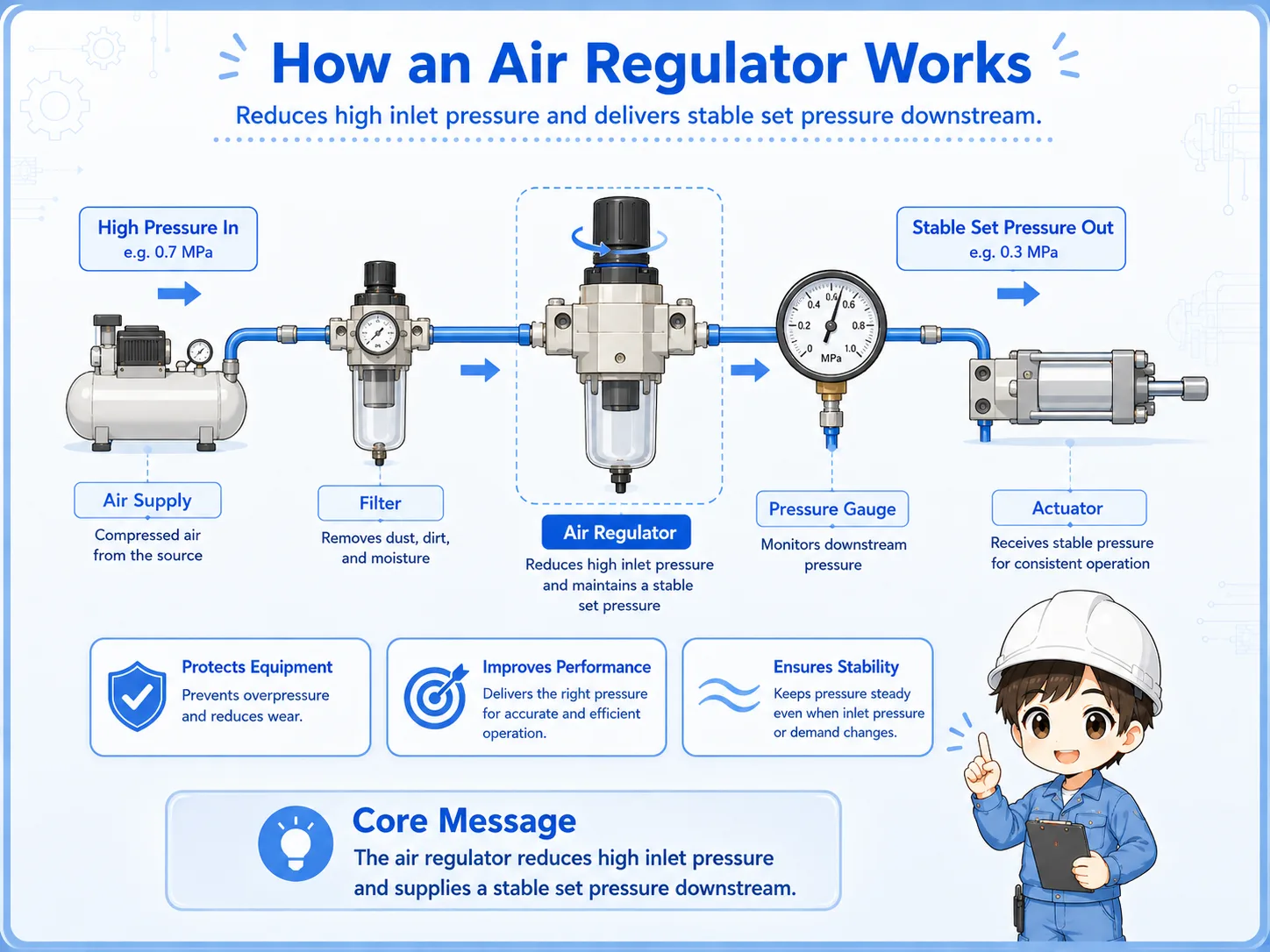
In a pneumatic system, compressed air from the main line is often higher than what a cylinder, valve, or other device should use directly. The regulator, sometimes called a pneumatic regulator, air pressure regulator, or compressed air regulator, is placed in the air line so the downstream side can receive a controlled pressure. The actual pressure range, port size, flow capacity, and adjustment method should be checked in the regulator manual and machine specification.
In simple terms, it works like a pressure adjustment point. The upstream side may have higher supply pressure, while the downstream side is set to the pressure the machine needs.
The regulator is not just a fitting
It is a control point for air pressure. If the setting is wrong, the machine may move weakly, too strongly, too fast, or in an unstable way.
Why pneumatic pressure needs adjustment
Different pneumatic devices need different working conditions. A cylinder that pushes a small part does not always need the same pressure as a larger actuator. A regulator helps match the air pressure to the task.
When pressure is adjusted correctly, the machine is easier to control. When it is not adjusted correctly, motion can become weak, rough, or inconsistent.
1. Main air supply
Compressed air enters from the upstream side.
2. Regulator
The pressure is adjusted to the set value.
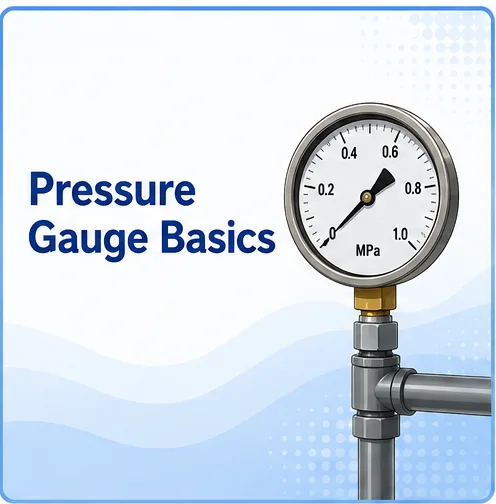
3. Gauge check
The adjusted pressure is read on the gauge.
4. Equipment
The downstream device receives controlled pressure.
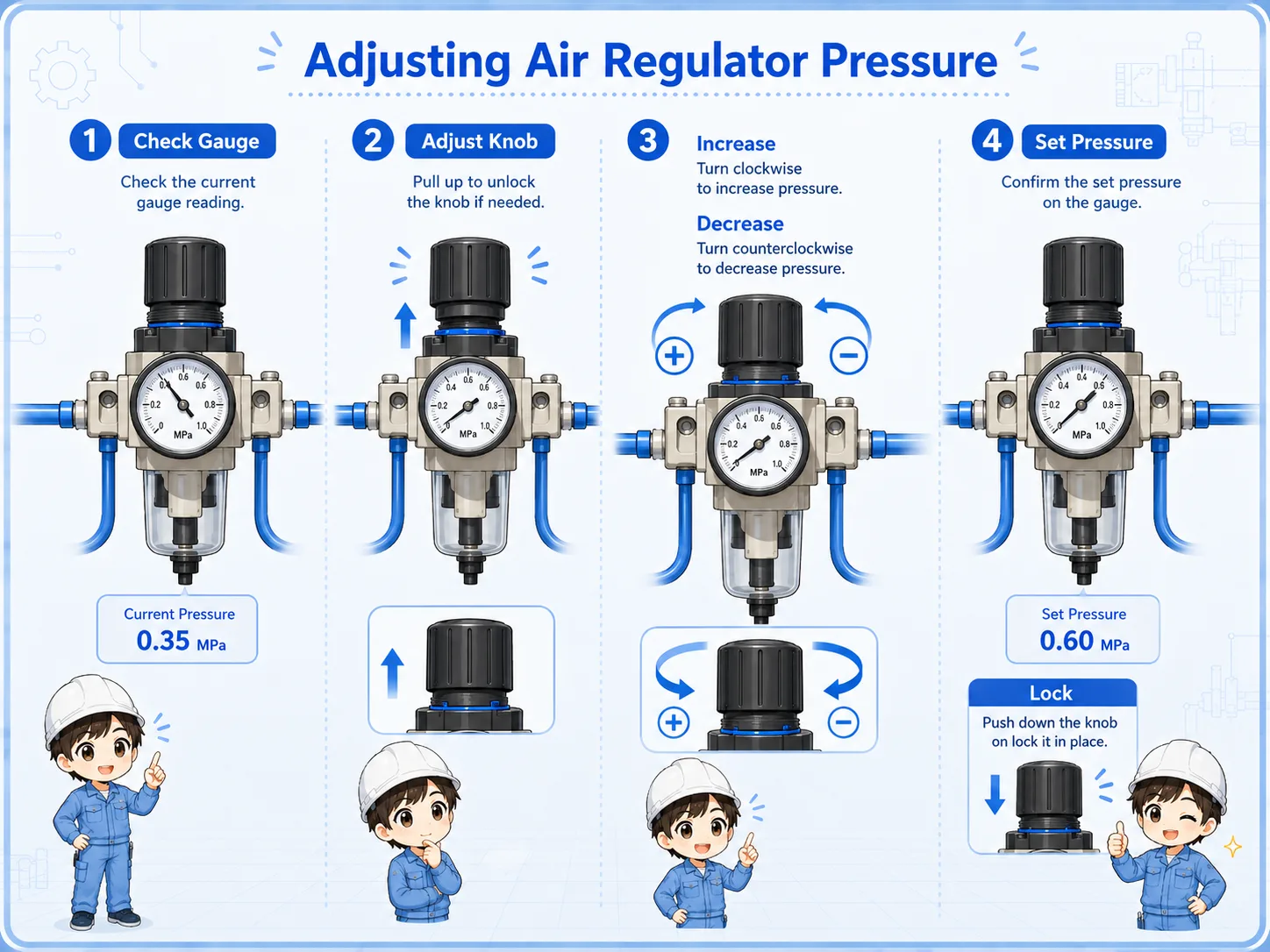
Do not adjust pressure without a reason
Turning the knob may seem simple, but pressure affects machine force and motion. Always confirm why the pressure is being changed and what value is required.
Regulator, pressure gauge, and filter relationship
In the field, a regulator is often seen together with a pressure gauge and an air filter. These parts have different roles, but they are closely related.
| Part | Main role | What to check |
|---|---|---|
| Air regulator | Adjusts downstream air pressure. | Set pressure, knob lock, pressure change when operating. |
| Pressure gauge | Shows the adjusted pressure. | Needle position, zero point, vibration, visibility. |
| Air filter | Removes water or particles from compressed air. | Bowl condition, drain, clogging, water accumulation. |
The gauge is important because it lets you see the adjusted pressure. However, a gauge reading alone does not prove that every downstream device is working correctly. Air leaks, clogged filters, damaged tubing, or mechanical resistance can still cause trouble.
What happens if pressure is too high or too low?
Pressure that is too low can make pneumatic equipment weak or slow. Pressure that is too high can make movement too strong, increase impact, or place extra load on parts.
Pressure too low
Cylinders may not extend fully, movement may become slow, or a device may fail to operate under load.
Pressure too high
Motion may become harsh, impacts may increase, and parts may wear or fail sooner.
Pressure unstable
Movement may change depending on timing, supply condition, leaks, or filter condition.
Gauge looks normal
The displayed pressure may be normal at rest, but it can drop during actual machine operation.
Pressure affects force
In pneumatic equipment, changing pressure can change the force and behavior of the mechanism. Do not raise pressure just to force a machine to move before checking the real cause.
Field checks before adjusting an air regulator
Before changing the regulator setting, it is better to check the surrounding conditions first. A pressure problem may not be caused by the regulator itself.
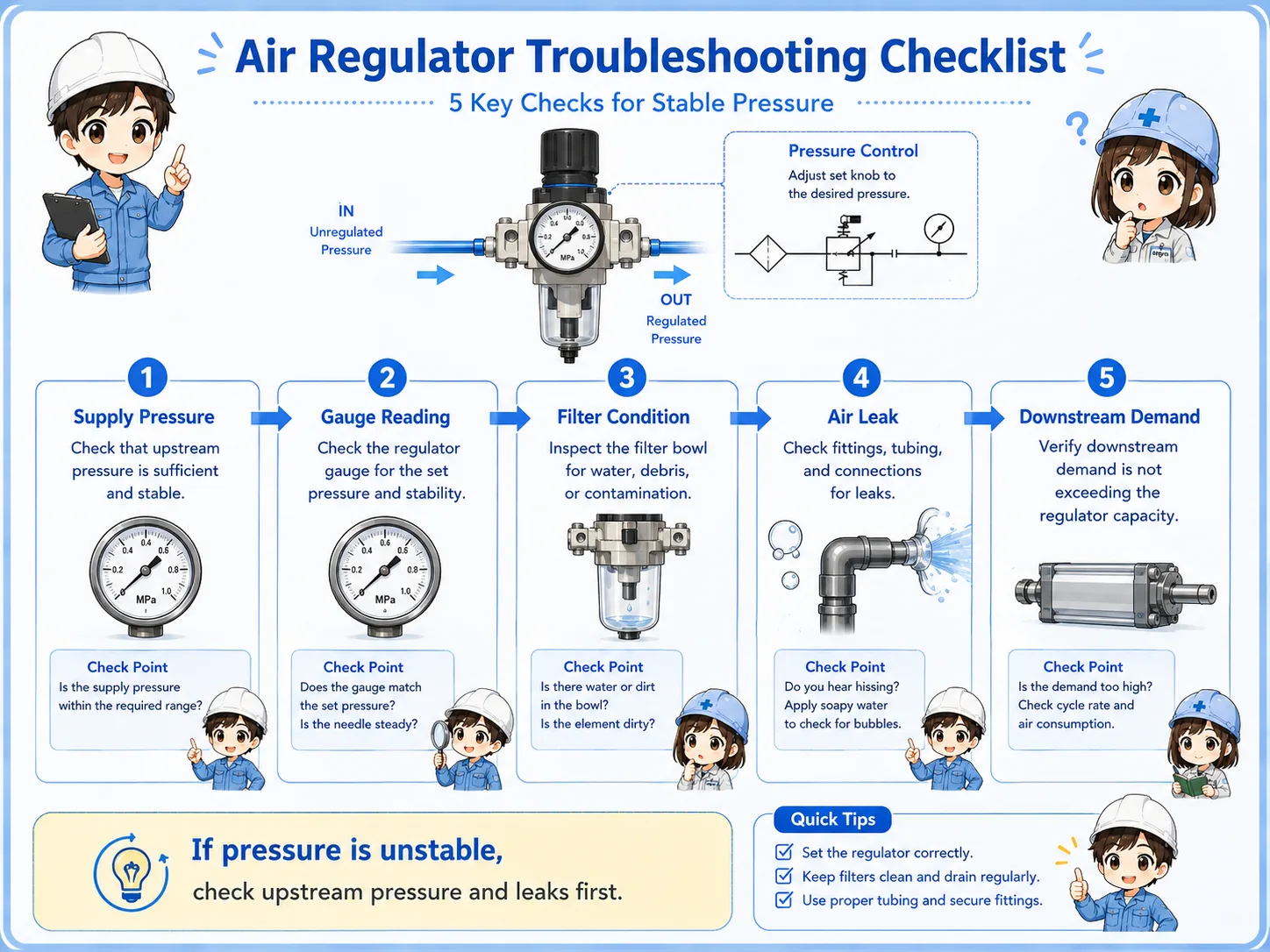
- Confirm the required pressure for the machine or device.
- Check whether the main air supply is stable.
- Look at the pressure gauge while the machine is operating, not only when it is stopped.
- Check the air filter bowl and drain condition.
- Check tubing, fittings, and nearby devices for air leaks.
- Confirm that mechanical movement is not blocked or overloaded.
Good field habit
If the machine suddenly needs more pressure than before, something else may have changed. Gauge pressure at rest may differ from pressure during operation, so watch the gauge while the actuator moves or while air is being consumed. Look for leaks, friction, clogging, wear, or load changes before simply raising the pressure.
Common troubleshooting points
When a pneumatic device does not move as expected, the regulator is only one part of the check. The following points are common in field troubleshooting.
| Symptom | Possible check point | Practical note |
|---|---|---|
| Cylinder is weak | Set pressure, pressure drop during operation, air leak. | Check pressure while the cylinder actually moves. |
| Movement is too fast or harsh | Pressure too high, speed controller setting, mechanical stopper. | Pressure and speed adjustment are different things. |
| Pressure does not rise | Main supply, regulator lock, filter clogging, upstream valve. | Check upstream side before replacing parts. |
| Pressure drops suddenly | Large air consumption, leak, undersized supply line. | Watch the gauge during machine operation. |
A simple way to think about it
An air regulator is like the pressure adjustment point before the equipment. It does not fix every air problem, but it decides the pressure supplied downstream.

So if the machine feels weak, I should not immediately turn the pressure up. I should check the gauge, leaks, filter, and machine condition first.
Summary: use the regulator as a controlled setting point
An air regulator adjusts pneumatic pressure so downstream equipment can operate under suitable conditions. It is closely related to the pressure gauge, air filter, tubing, and the actual machine movement.
When checking a machine, do not treat the regulator knob as the first solution. Confirm the required pressure, watch the gauge during operation, and check for leaks, clogging, or mechanical load before changing the setting.