What is a panel heater?
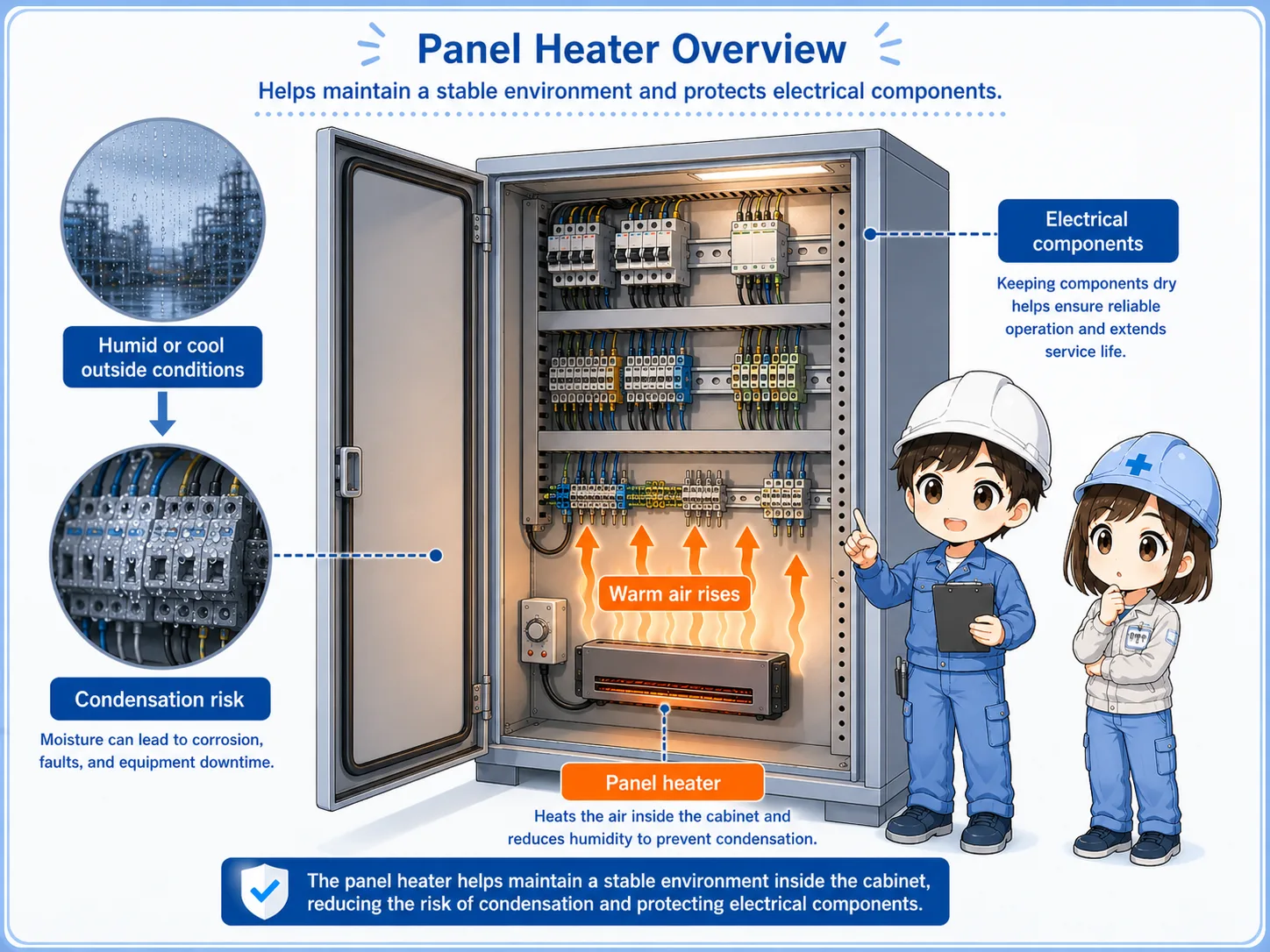
A panel heater is a small heating device installed inside a control cabinet to help prevent moisture problems.
In a control cabinet, condensation can form when the cabinet surface and internal air temperature change quickly. Moisture on terminals, relays, power supplies, PLC modules, and wiring can lead to corrosion, insulation problems, or unexpected trouble over time.
A panel heater gently warms the inside of the cabinet so that moisture is less likely to condense on electrical parts. It is usually paired with a thermostat or temperature controller, depending on the design.
Think of it as condensation prevention, not room heating
The purpose is not to heat the workplace. The purpose is to keep the cabinet interior in a more stable condition so moisture does not easily collect on electrical components.
Why condensation can happen inside a control cabinet
Condensation is often related to temperature difference, humidity, and time of day.
A cabinet may look sealed, but its internal temperature can still change. For example, a cold morning after a humid night, a panel installed near an outdoor wall, or equipment that stops at night and restarts in the morning can create conditions where moisture appears on metal surfaces.
- Temperature drop: the cabinet or internal parts become colder than the surrounding humid air.
- Humidity: moist air enters or remains inside the enclosure.
- Cold metal surfaces: terminals, rails, or cabinet walls become places where water droplets can form.
- Long stopped periods: equipment that is not operating may not generate enough internal warmth.
When you see a heater in a cabinet, first think about moisture and condensation. It is often there to protect the panel environment, not to warm the operator.
So if the panel is already too hot, adding or increasing a heater would be the wrong idea. For heat problems, I should look at fans, filters, airflow, and heat sources.
Panel heater vs cooling fan
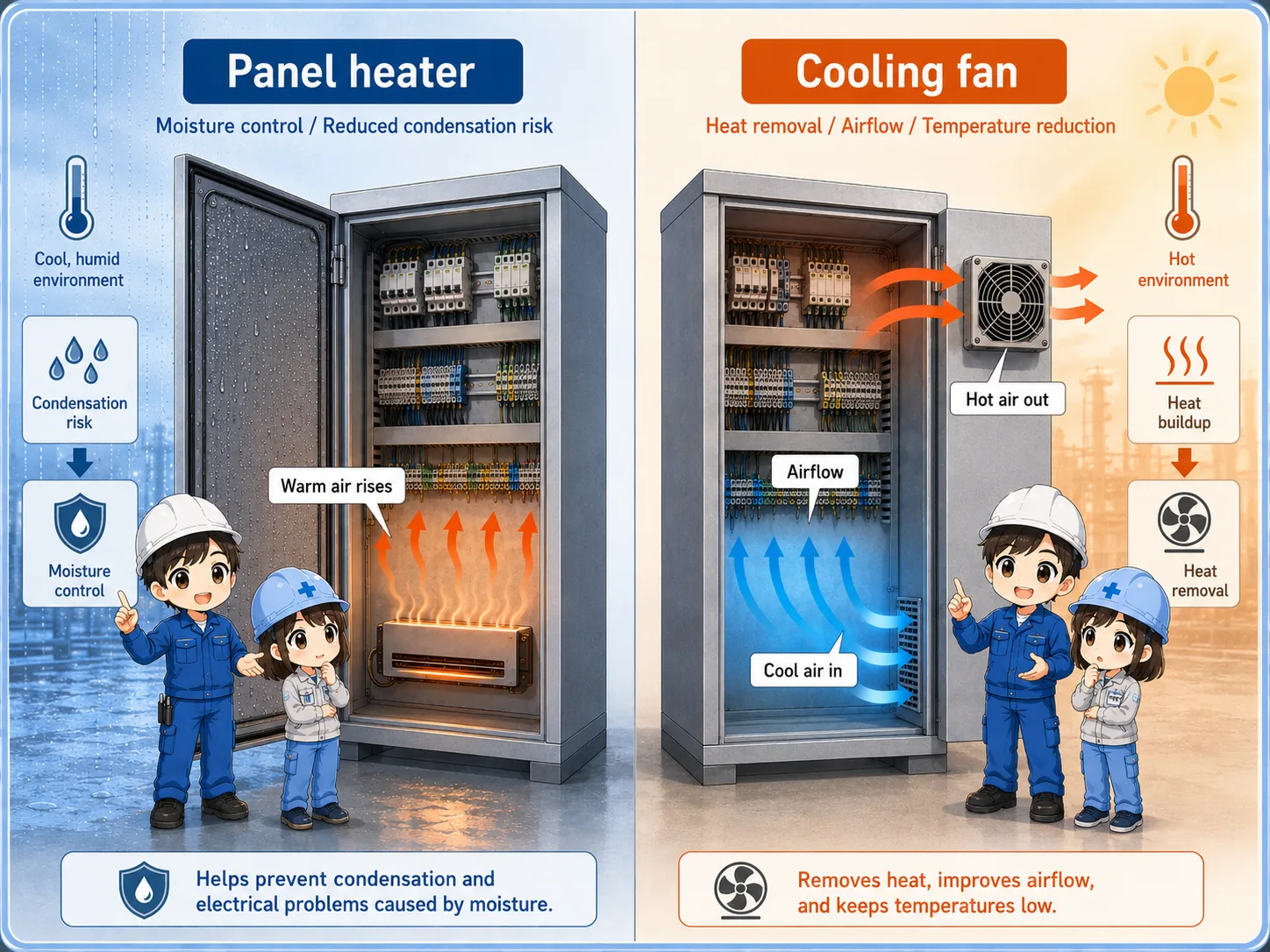
A heater and a fan solve different problems, even though both are related to cabinet environment.
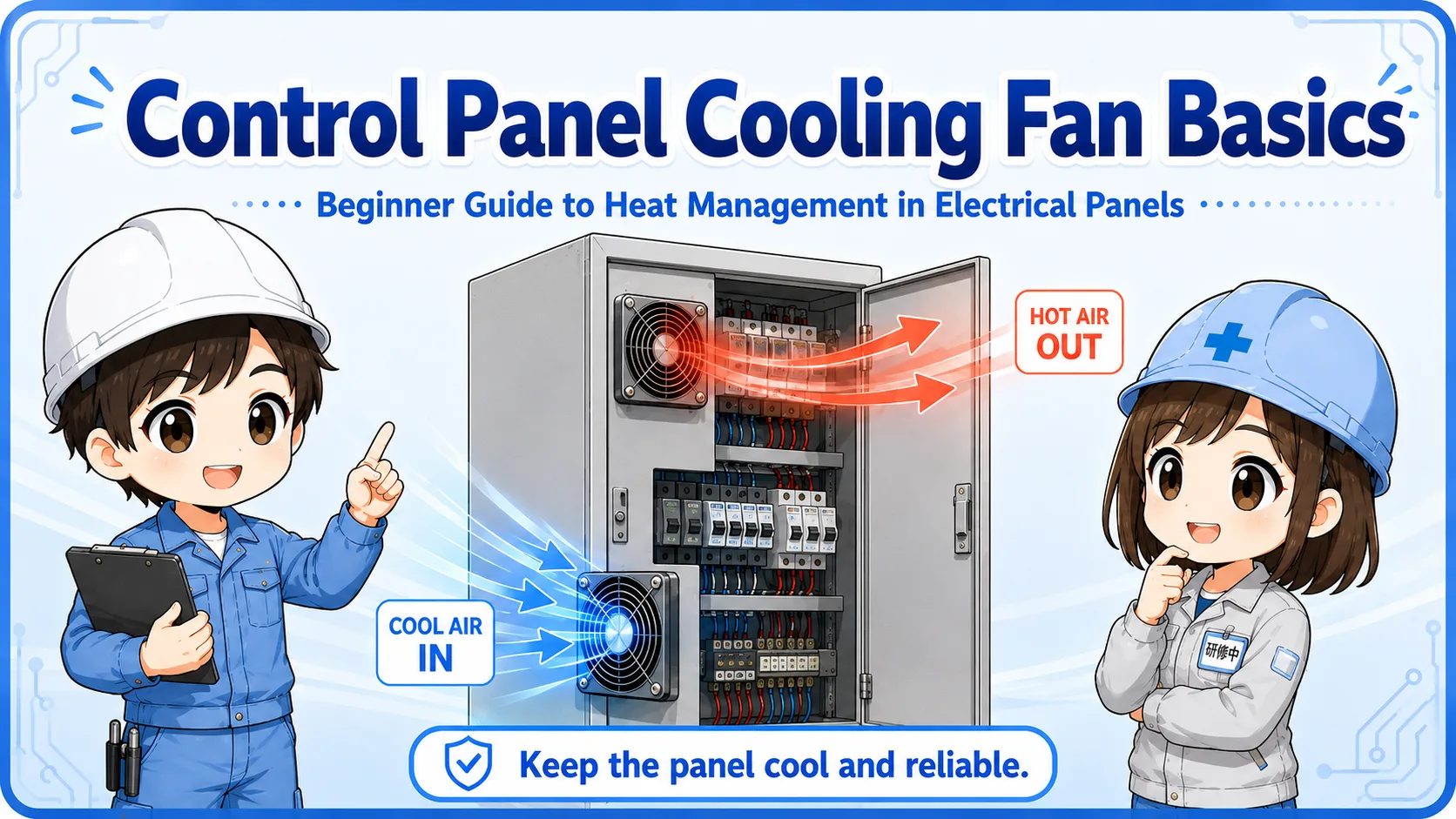
A common beginner mistake is to treat a panel heater and a cooling fan as similar temperature parts. In practice, they have almost opposite roles. A cooling fan is used when the cabinet becomes too hot. A panel heater is used when condensation risk is the concern.
| Item | Panel heater | Cooling fan |
|---|---|---|
| Main purpose | Reduce condensation risk | Remove or move heat |
| Typical concern | Moisture, dew, cold morning, humid environment | High panel temperature, hot components, poor ventilation |
| Control method | Often controlled by a thermostat or temperature switch | Often controlled by temperature, operation status, or continuous ventilation design |
| Field check | Check heater power, thermostat, clearance, and moisture marks | Check fan rotation, filter clogging, airflow direction, and heat source |
Why a thermostat is usually important
The heater should not be treated as a simple part that is always powered without checking the control method.
Many cabinet heater setups use a thermostat so the heater operates only when the cabinet temperature is below the intended range. The exact control method depends on the product, cabinet design, and site requirements.
1. Cabinet gets cold
The internal temperature drops and condensation risk increases.
2. Thermostat closes
The heater circuit is allowed to operate, depending on the wiring.
3. Heater warms air
The cabinet interior becomes less likely to collect moisture.
4. Thermostat opens
When the set condition is reached, heating stops or is limited.
Check the actual device manual
Terminal names, wiring method, set temperature, rated voltage, and mounting conditions differ by model. Always confirm the actual product manual and panel drawings.
Placement and selection thinking
The heater must be selected and mounted as part of the cabinet design, not as a random added part.
The correct heater capacity and placement depend on cabinet size, enclosure material, ambient temperature, humidity, mounting environment, ventilation, and safety clearance. This article explains the basic thinking, but the actual selection should follow manufacturer data and the panel design standard used at the site.
Rated voltage and power
Confirm that the heater voltage, power, protection, and wiring match the panel design.
Mounting position
Warm air rises, so placement and airflow path matter. Avoid blocked areas.
Clearance from wiring
Do not let cables, labels, ducts, or plastic parts touch or cover the heater.
Thermostat location
Place and wire the thermostat according to the intended sensing point and manual.
Field checks for a panel heater
When checking a cabinet heater, look at the heater, thermostat, wiring, and moisture signs together.
A panel heater may be small, but it is still an electrical device inside the cabinet. Check it carefully and safely. Do not touch live parts. Do not touch the heater surface until you know it is safe and cool enough.
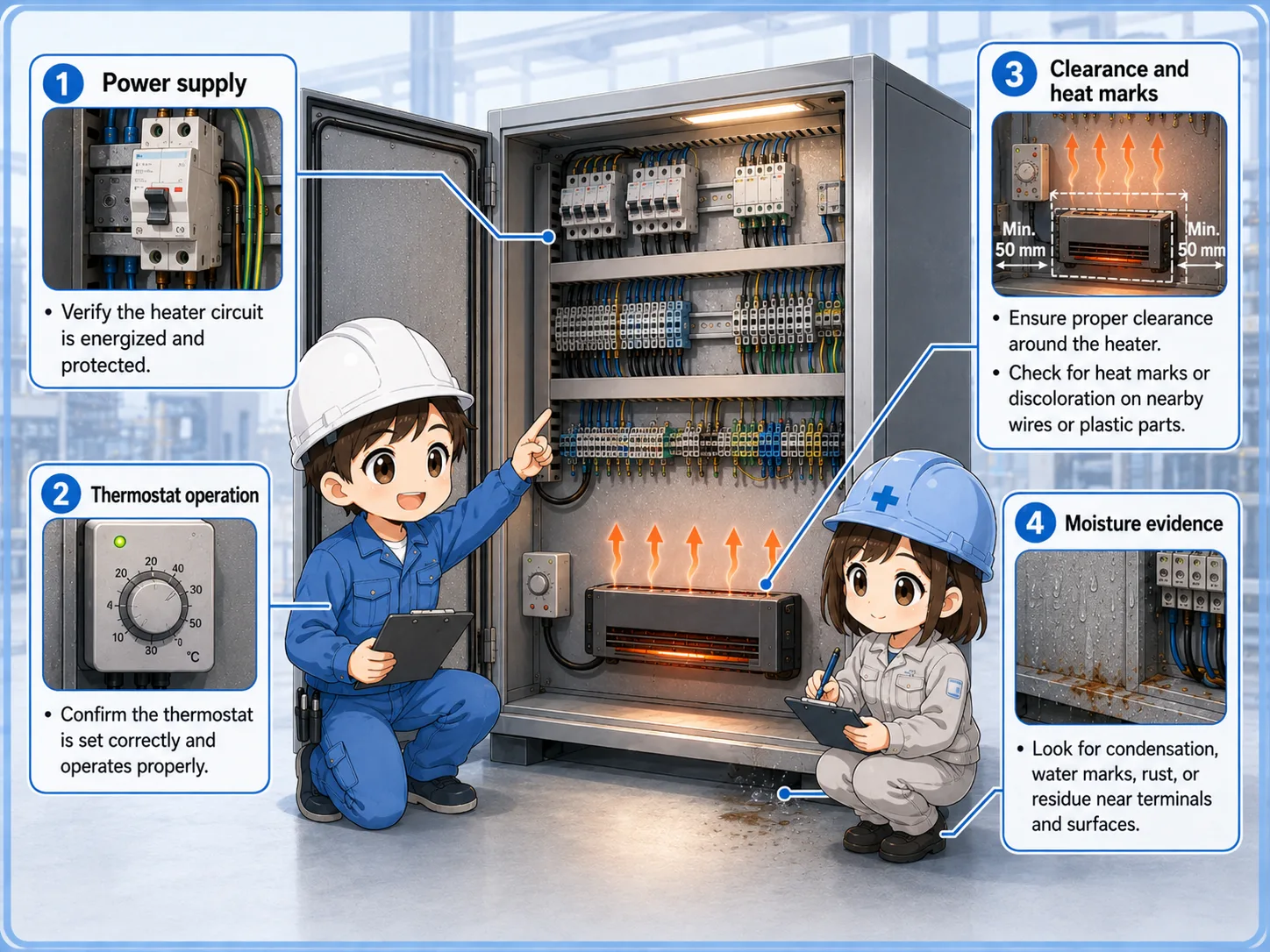
Power supply
Check the heater circuit source, protection device, voltage, and wiring route against the drawing.
Thermostat operation
Confirm whether the thermostat is calling for heat and whether the heater should be on.
Clearance and heat marks
Look for covered heaters, nearby wires, discoloration, damaged labels, or overheated parts.
Moisture evidence
Look for water marks, rust, white residue, or condensation traces around terminals and the cabinet wall.
Safety first
Work inside control panels only according to site safety rules. De-energize when required, confirm absence of voltage, and follow the actual drawings and manuals.
Common mistakes
Most mistakes come from confusing condensation prevention with heat removal.
- Using a heater for a hot cabinet: if the panel is overheating, check cooling fans, filters, ventilation, heat sources, and layout instead.
- Covering the heater: blocked airflow can reduce effectiveness and may create a heat problem near wiring or plastic parts.
- Ignoring the thermostat: a failed or incorrectly set thermostat can make the heater run at the wrong time or not run when needed.
- Assuming all heaters are wired the same: terminal names, voltage, and protection differ by model and panel design.
- Only checking the heater: moisture problems may also involve enclosure sealing, cable entries, drain parts, or environment around the panel.
Summary: read a panel heater as a moisture-control part
A panel heater is best understood as a condensation prevention part inside a control cabinet. It helps keep the internal environment stable when humidity and temperature changes could cause moisture to collect on electrical parts.
For field checks, do not look at the heater alone. Check the thermostat, wiring, voltage, protection device, mounting clearance, cabinet environment, and signs of moisture together. For exact wiring and settings, always follow the actual panel drawing and the product manual.